
After checking the property and verifying the documents of both the property and the seller, having engaged legal expertise, going through a series of negotiations concerning the price and transfer dates, you finally sign the Sale and Purchase Agreement (also known as MOU or Form F) and might think that the deal is sealed and it is secure, -except it isn’t-.
What if a seller decides to cancel the deal after signing it? Within the robust real estate market in Dubai, such a query takes the lead on to a legal minefield.
According to the Law No. 7 of 2006 Concerning Land Registration in the Emirate of Dubai, a property is defined as “Any immoveable object with a fixed space that cannot be moved without destroying or changing its feature”. With the vital increase in demand, built upon strong economy, and ever-evolving government regulations, property purchase agreements have taken a major growth spiral, and so have their disputes.
Legal Power of the SPA (Signed Purchase Agreement):
In Dubai, property transactions are governed by the Dubai Land Department (DLD), according to UAE Civil Laws, Law No. (7) of 2006 and Law No.13 of 2008 and their amendments. [MM1] UAE law recognizes the validity of both oral and written agreements or contracts, once there is evidence providing proof for oral contracts.
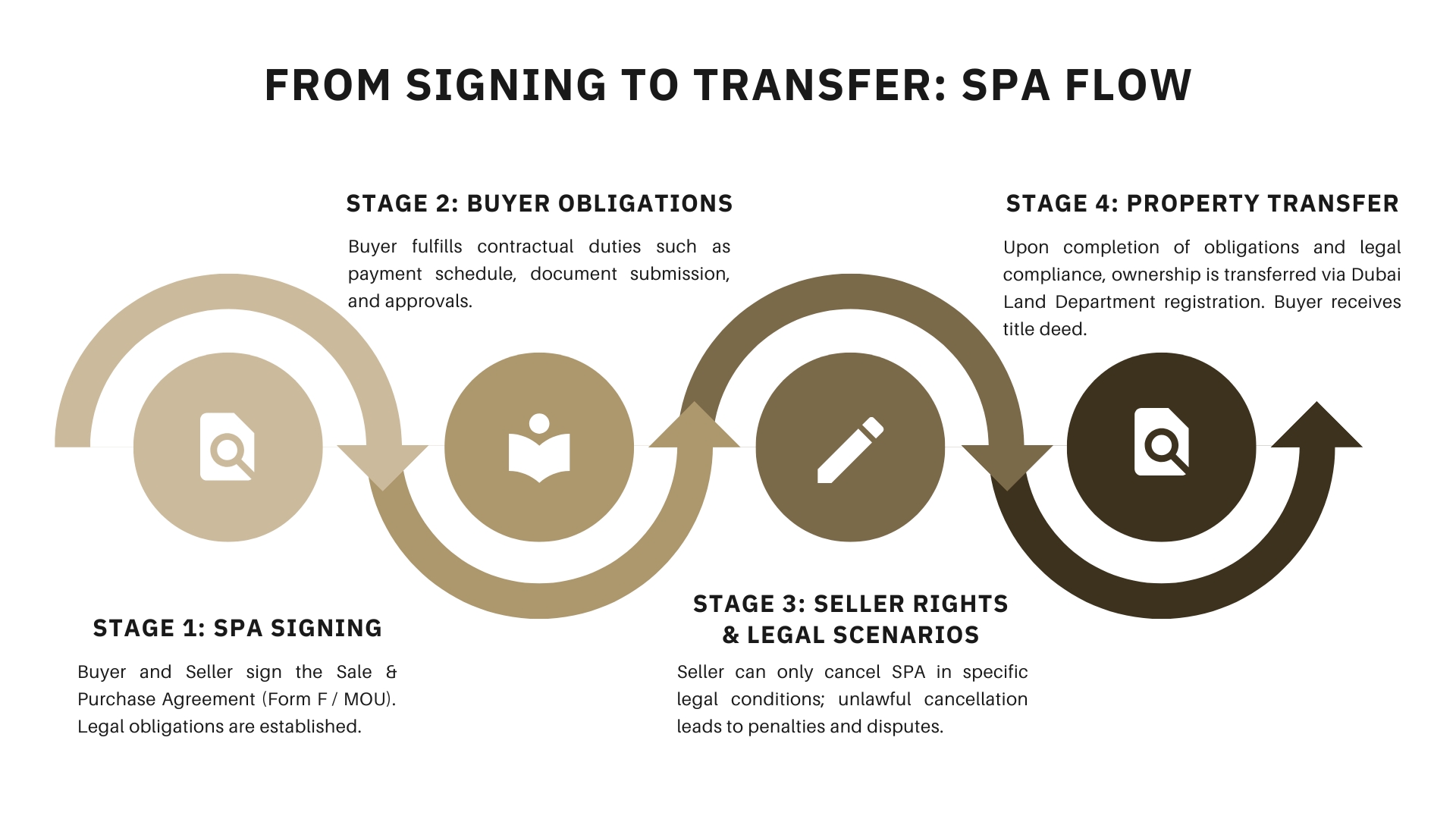
It is global common knowledge that any agreement becomes binding the moment of signing it. In the case of property transactions, an agreement is binding once it is registered with the DLD department. A property sales agreement -also known as Memorandum of Understanding (MOU), or Form F- is a legally binding document agreed upon by the parties. Once signed and registered, the seller has an obligation to transfer ownership of the property, and the buyer has the obligation to purchase.
An SPA usually includes a payment schedule, timelines for handover, transfer, and completion date in case of an off-plan property, penalties for delays, defaults, or penalties upon failure to meet contractual obligations.
Revoking such a binding document without any legal justification can lead to penalties and legal disputes.
Is It Possible for a Seller to Cancel a Property Sale Agreement in Dubai?
Yes, but it is restricted to certain cases and regulated accordingly:
“Article 267 of the UAE Civil Code states that ‘if a contract is valid and binding, it shall not be permissible for either of the contracting parties to resile from it, or vary or cancel it, save by mutual consent, or an order of the court, or under a provision of the law”.
A seller cannot simply decide to cancel the written and signed agreement without any legal basis or without any of the conditions mentioned within the above clause. Note that prior to signing it, no legal consequences arise; however, if the decision to cancel was taken after the signing, it is only considered legal in the following circumstances:
- The buyer fails to meet contractual obligations, for instance he falls behind on presenting payments on the agreed dates.
- The SPA includes clauses that grant the seller the right to do the cancellation if certain conditions are not met, or through a separate written mutual agreement document.
- Force majeure situations, such situations are mostly known as natural disasters, or sudden emergencies, they are very rare and require proof.
- For off-plan properties, developers must comply with Law No.13 of 2008 for off-plan regulations and its amendments in 2010. In case of a breach by the buyer, “a Developer or seller can cancel the agreement and keep a portion of the paid amount (varies by the paid amount or percentage)”.
Legal Repercussions for Seller Initiated Cancellation
The seller must first review the SPA carefully, and check for any clause that allows such cancellation, then he must inform the buyer in case of any missed payment or a specific unmet condition and inform the DLD department. If the issue is unresolved and no mistake has been made from the buyer’s end, then it is considered as a breach of the contract, entitling the buyer to:
- File a claim with the relevant court or force the seller to proceed with the sale in some cases and transfer the property’s possession.
- The buyer may also decide to take the matter to Dubai Courts to seek proper justice and compensation for losses.
- Seek compensation for damages created by the seller for the last-minute deal withdrawal. As the buyer attempts to purchase another property, and he ends up paying more, then it is rightful to demand compensation from the original seller.
How Is the Buyer Protected?
The buyer is often entitled with more duties than rights when it comes to property transactions and agreements, but he also has the right to be protected from unjust seller’s acts.
Most SPAs include arbitration or court dispute resolution mechanisms, granting buyers the right to:
- approach Dubai Courts, RERA, and DIAC (Dubai International Arbitration Center) in case of an unlawful breach of contract, buyers should always make sure that the SPA includes clear clauses for refunds, penalties, and dispute resolutions.
- Title deeds and Uqood (proof of possession in case of an off-plan property) act as legal ownership protection documents and prevent unauthorized resale.
- UAE’s civil code supports the compensation of buyers in case of damages, such as bad faith from the seller or unjust cancellation.
- Escrow Account Protection (for off-plan projects), these allow for the buyer payments to go into the escrow specific account, not directly to the developer, ensuring that the funds used are only for that project, reducing fraud risk.
Alternative Solutions to Avoid Disputes
- If a dispute arises, it’s best to try direct negotiation first, if all else fails, resort to mediation services offered by RERA, mediation offered by Dubai’s Real Estate Arbitration Center, is often faster, and cheaper.
- Arbitration can also be a good option, matters are kept private and lengthy court battles are avoided, in addition to the fact that their issued sentences are enforceable and binding in the UAE.
- It’s also advised to settle the issue and have a mutual agreement to amend the contract rather than bearing courts’ expenses and going through long procedures to resolve the matter.
- If the payments are not handed in on time, parties could consider rescheduling payments
Final Thoughts
Sale and Purchase Agreement cancellation can be grave accompanied by legal and financial consequences. Even if sellers present legitimate reasons to terminate an SPA, without reference to the terms of the agreement and the governing laws, cancellation can result in penalties, legal disputes, and reputational damage.
Whether the property is off-plan or ready, sellers should seek proper legal advice, communicate openly with the buyer, and explore alternative solutions, such as mutual cancellation or renegotiation-before taking any drastic steps.
Eventually, prevention is better than cure. Sellers should make sure to carefully draft the SPA, include clear cancellation clauses, and the protection of interests all while complying with UAE’s real estate regulations.Frequently Asked Questions:
In Case of a Signed SPA but Not Yet Registered, Is It Still Enforceable?
Yes, an unregistered SPA is still legally binding once signed by the parties, registration grants it more power to have immediate function, but it is still considered legal.
Can an SPA Be Paused or “Frozen” Instead of Cancelled?
Yes, if both parties agree, SPA can be amended or put on hold through a written addendum, this is mostly useful in cases of unexpected delays in financing or certain approvals.
Does the Death of the Buyer Terminate the SPA?
No, death does not automatically cancel the SPA, as legal heirs may inherit the obligations unless stated otherwise.
Is it Possible to Cancel the SPA for Iniquity?
No, in case the property market’s value drastically changed upon the issuance of the SPA, let it be a drop or rise, this does not qualify for a cancellation, and the price listed within the SPA is considered binding.
Disclaimer: The content on this page is for general information purposes only and does not constitute as legal advice nor should it be used as a basis for any specific action or decision. Nothing on this page or website is to be considered as rendering of legal advice or legal services for any specific matter. Users of this website are advised to seek specific legal advice by contacting a lawyer regarding any specific legal issues.