
Dubai’s competitive rental market continues to grow, driven by business-friendly policies, infrastructure development, and the Golden Visa programme. For both landlords and tenants, understanding Dubai rental laws is not optional, but compulsory. Non-compliance to fulfill any obligations, whether intentional or not, can result in significant penalties.
This expert guide covers everything you need to know: tenancy agreements, tenant rights, security deposits, eviction rules, subletting restrictions, and how to file a rental dispute with the Rental Disputes Centre (RDC).
Legal Foundation: Dubai Tenancy Laws
Dubai rental law is primarily governed by Law No. 26 of 2007, as amended by Law No. 33 of 2008. These laws define the rights and obligations of landlords and tenants, set the rules for eviction notices, rent increases, and contract renewals, and establish the Rental Disputes Centre (RDC), the official body for resolving all rental conflicts in Dubai.
All tenancy contracts must be registered through Ejari, Dubai’s official tenancy registration system operated under RERA. Without Ejari registration, a contract is not legally enforceable, and both the landlord’s eviction rights and the tenant’s protections are significantly weakened before the RDC.
Tenant Rights & Common Rental Issues
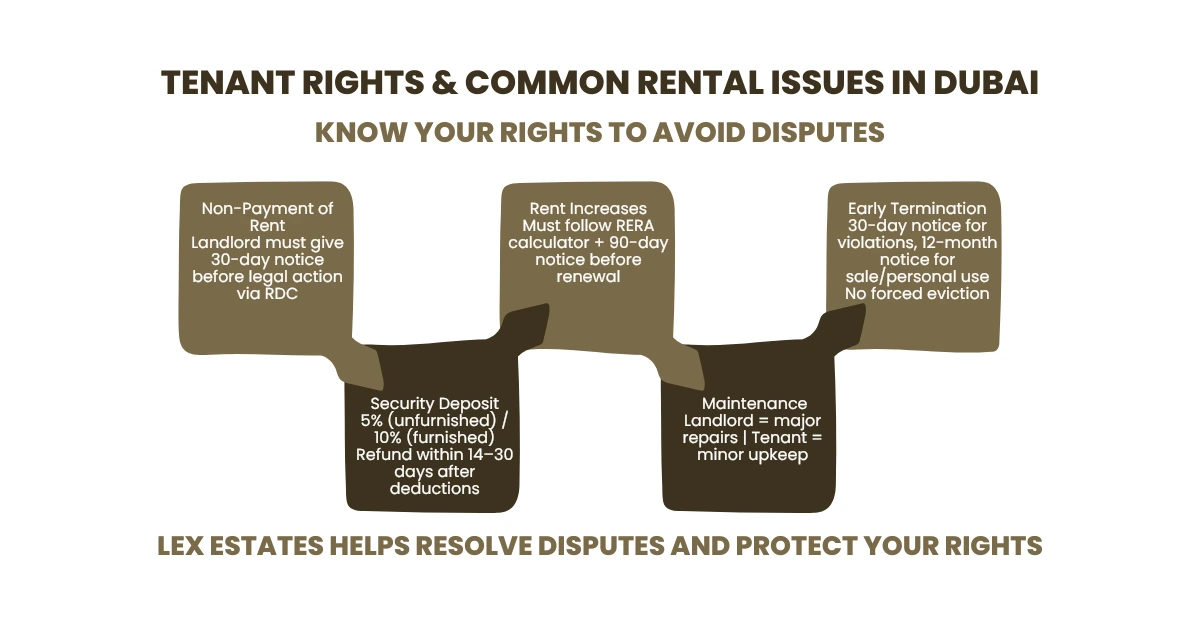
Dubai rental law protects both tenants and landlords. Knowing where the boundaries lie, on rent, deposits, maintenance, and contract terms, helps both parties avoid costly disputes before they escalate.
Non-Payment of Rent:
If a tenant fails to pay rent, the landlord must issue a formal 30-day notice demanding payment before taking any further action. If the tenant does not pay within that period, the landlord may file a case with the RDC and seek both eviction and recovery of the outstanding amount.
Security Deposits:
The security deposit is typically 5% of the annual rent for unfurnished properties and up to 10% for furnished properties. It must be recorded in the tenancy contract and a receipt provided to the tenant. Upon lease expiry, the deposit must be returned within 14–30 days, minus any deductions for damage beyond normal wear and tear.
Rent Increases:
Landlords in Dubai cannot increase rent arbitrarily. Any rent increase must comply with the RERA Rent Calculator, which determines the permissible increase based on the current market rate. A minimum of 90 days’ written notice must be given prior to the expiry of the contract before any rent change takes effect at contract renewal.
Maintenance & Repair Responsibilities:
Under Dubai rental law, the landlord is responsible for major structural repairs and maintaining the property in a liveable condition. Tenants are responsible for minor day-to-day upkeep. If a landlord fails to carry out necessary repairs after being formally notified, the tenant can escalate the matter to the RDC.
Early Termination by the Landlord:
A landlord can only terminate a tenancy contract early on legally recognised grounds. Contract violations such as non-payment require a 30-day notice, while termination for property sale or personal use requires a full 12-month notarised notice. A landlord cannot force a tenant out or change the locks without a court order.
Legal Restrictions on Subletting
Under Article 24 of Law No. 26 of 2007, a tenant cannot sublet a property, wholly or partially, without prior written consent from the landlord. Subletting without permission entitles the landlord to terminate the lease and file a case with the RDC. Penalties for illegal subletting can reach up to AED 50,000, with additional fines for overcrowding or unauthorized partitions.
To sublet legally, tenants must: obtain a written No-Objection Certificate (NOC) from the landlord, draft a separate sublease agreement, register the subtenant via the Dubai REST app, and comply with Dubai Municipality occupancy and safety rules.
Eviction Rules in Dubai
The procedure for evicting a tenant in Dubai begins with identifying a legally recognized ground, such as non-payment, property sale, or personal use, and serving a written notarized notice within the correct timeframe. If the tenant refuses to vacate after the notice period expires, the landlord must file a case with the Rental Disputes Centre (RDC) to obtain an enforceable eviction order.
Valid Grounds for Eviction
A landlord may only evict a tenant on the following legally recognized grounds:
- Non-payment of rent: 30-day notice required.
- Breach of tenancy contract (e.g., unauthorized subletting): 30-day notice required.
- Property sale: 12-month notarised notice required.
- Landlord’s personal use: 12-month notarised notice required.
- Demolition or major renovation: 12-month notarised notice required.
- Property is unsafe or uninhabitable: either party may terminate immediately.
Serving an Eviction Notice:
An eviction notice must be served in writing, clearly stating the legal reason and the vacating date. It is only legally valid if delivered via a registered Notary Public or registered mail. WhatsApp, email, and verbal notices carry no legal standing. Proof of delivery must be retained for use at the RDC.
Online Notarisation of Eviction Notices:
Landlords can now notarise eviction notices online via Dubai Courts E-Notary or licensed private notaries. The process involves booking, uploading the notice, identity verification via video call, and receiving a digitally signed PDF with a QR verification code, fully recognised under RERA rules.
Evicting for Personal Use:
A landlord may reclaim the property for personal use or for a first-degree relative with a 12-month notarised notice. Once the property is vacated, the landlord may not re-rent it for 2 years for residential properties, 3 years for commercial properties. Doing so entitles the former tenant to seek compensation through the RDC.
What Happens If a Tenant Refuses to Leave?
If a tenant refuses to vacate after a valid eviction notice, the landlord must file a case with the RDC, not take matters into their own hands. Changing locks or cutting utilities is illegal. The RDC will attempt mediation first; if unsuccessful, a court eviction order is issued and enforced by authorities.
Contesting an Eviction Notice
Tenants have the right to challenge an eviction notice at the RDC under Law No. 26 of 2007 and Law No. 33 of 2008. Valid grounds for contesting include: no valid legal reason, incorrect notice period, defective or improperly served notice, or lack of notarisation.
Required documents include: tenancy contract, Ejari certificate, Emirates IDs, proof of rent payment, and communication history. The RDC process begins with mediation and moves to court hearings if no agreement is reached. Case status can be tracked online via the RDC portal.
Filing a Case at the Dubai Rent Committee
The Rental Disputes Centre (RDC), established under Decree No. 26 of 2013, is the exclusive judicial body for landlord-tenant disputes in Dubai. Cases can be filed online via the Rent Dispute Resolution Portal on the DLD website, or in person at the RDC Head Office in Deira.
Filing fees are 3.5% of the annual rent, minimum AED 500 and maximum AED 20,000 for rental disputes. The RDC first attempts amicable settlement (target: 15 days). If mediation fails, the case proceeds to the First Instance Committee (target: 30 days). Appeals may be filed within 15 days of judgment for cases exceeding AED 50,000.
Lex Estates: Dubai Property Done Right, Every Time
Navigating Dubai rental laws can be complex, but you don’t have to do it alone. Whether you are looking to buy, sell, or manage property in Dubai, Lex Estate’s experienced property specialists are here to help. From tenant sourcing and full-service property management to buy-and-sell guidance across Dubai, we ensure your investment is always in the right hands.
Dubai’s property market rewards those who get it right. Whether you are a first-time buyer, a seasoned investor, or a landlord looking for reliable tenants, Lex Estates is the partner you need. We bring the market knowledge, you bring the vision, together we make it work. Contact Lex Estate today.
Frequently Asked Questions
What are the main laws governing Dubai rental agreements?
Dubai rental law is governed by Law No. 26 of 2007 and its amendment, Law No. 33 of 2008. These laws cover tenancy contracts, rent increases, eviction rules, and dispute resolution through the RDC.
How much notice must a landlord give before eviction in Dubai?
It depends on the reason. Non-payment or contract violations require 30 days. Property sale, personal use, or major renovation requires a full 12-month notarised notice.
What is the security deposit in Dubai?
The security deposit is 5% of the annual rent for unfurnished properties and up to 10% for furnished properties. It must be returned within 14–30 days of lease expiry, minus any legitimate deductions.
Can a tenant sublet a property in Dubai?
Yes, but only with written landlord approval. Subletting without consent is illegal and can result in lease termination and fines of up to AED 50,000.
How do I file a rental dispute in Dubai?
File a case at the Rental Disputes Centre (RDC), online via the DLD’s Rent Dispute Resolution Portal, or in person at the RDC Head Office in Deira. Fees are 3.5% of the annual rent, minimum AED 500.