You signed the SPA. You paid the booking amount. Then life happened, and the installments stopped. Now the question arises, “What happens if a property buyer stops paying installments to the developer?
You may lose some or all of your investment, and it depends on the development stage of the project. Why? Because once you sign a Sales and Purchase Agreement (SPA), you are legally bound to follow the payment schedule.
Missing payments does not just mean a late fee. In Dubai, it triggers a strict legal process governed by the Dubai Land Department, one that can end with you losing a significant portion of everything you have already paid.
What Does Dubai Law Say About Missed Installment Payments?
The off-plan property market in Dubai follows these laws.
- Law No. 13 of 2008: Regulating the Interim Real Property Register
- Law No. 19 of 2017: Amended Interim Real Property Register Law
When a buyer fails to pay installments, the developer must first notify the Dubai Land Department (DLD). Once the DLD confirms the buyer is in breach of contract, it serves a 30-day written notice to the buyer to fulfil their contractual obligations. The notice must be delivered in person, by registered mail, or by any DLD-approved method.
During this 30-day window, the DLD also attempts to mediate an amicable settlement between both parties. This is your most important window, and most buyers miss it completely.
Consequences Buyers may face after 30-Day Notice expires
If you do not respond or pay within 30 days, the developer’s legal rights kick in, and they vary based on how much of the project is complete at the time of default.
Project construction is 80% and above
If the developer has completed more than eighty percent (80%) of the project, the Developer may take any of the following measures against the purchaser without recourse to courts or arbitration:
1) Maintain the sale agreement concluded with the buyer and retain all amounts paid by the buyer, and claim the balance of the price of the property from the buyer
2) request the DLD to sell the property by public auction to collect the remaining amounts payable to the Developer; and hold the purchaser liable for the costs arising from the sale; or
3) unilaterally terminate the contract, retain up to forty percent (40%) of the value of the property stipulated in the sale agreement, and refund any amounts in excess of this to the purchaser within one (1) year from the termination of the agreement or within sixty (60) days from the date of resale of the unit to another purchaser, whichever occurs earlier.
Between 60% and 80% Complete
The developer may terminate the contract unilaterally, deduct up to forty percent (40%) of the property value, and refund the excess to the buyer within one (1) year from the termination of the agreement or within sixty (60) days from the date of resale of the unit to another buyer, whichever occurs earlier.
Construction Below 60% Complete
The developer may terminate the contract and keep up to 25% of the property’s value. The remaining balance must be refunded to the buyer within one (1) year from the termination of the agreement or within sixty (60) days from the date of resale of the unit to another buyer, whichever occurs earlier.
Construction Not Yet Started
Where the developer has not started the construction of the property for any reason beyond his control, without negligence or omission on his part, he may terminate the sale agreement, retain up to thirty percent (30٪) of the amounts paid to him by the purchaser, and refund any amounts in excess of this to the purchaser within sixty (60) days from the termination of the agreement.
What Can the Developer Keep? A Clear Breakdown
| Construction Stage | Developer’s Right | Refund to Buyer |
| Above 80% complete | Any of the following actions: 1) maintain the contract and demand the balance from the buyer; 2) auction the unit through DLD to recover the balance; or 3) terminate the contract and retain 40% of the property value and refund the excess to the buyer | deduct 40% of the property value and refund the excess to the buyer |
| 60%–80% complete | Terminate + deduct 40% of the property value | Remaining balance within 1 year of termination or 60 days of selling to another buyer |
| Below 60% complete | Terminate + retain up to 25% of property value | Balance refunded within 1 year of termination or 60 days of selling to another buyer |
| Not started | Terminate + retain up to 30% of the payment made by the buyer | Balance refunded within 60 days of termination |
Consequences if a buyer stops paying Installments
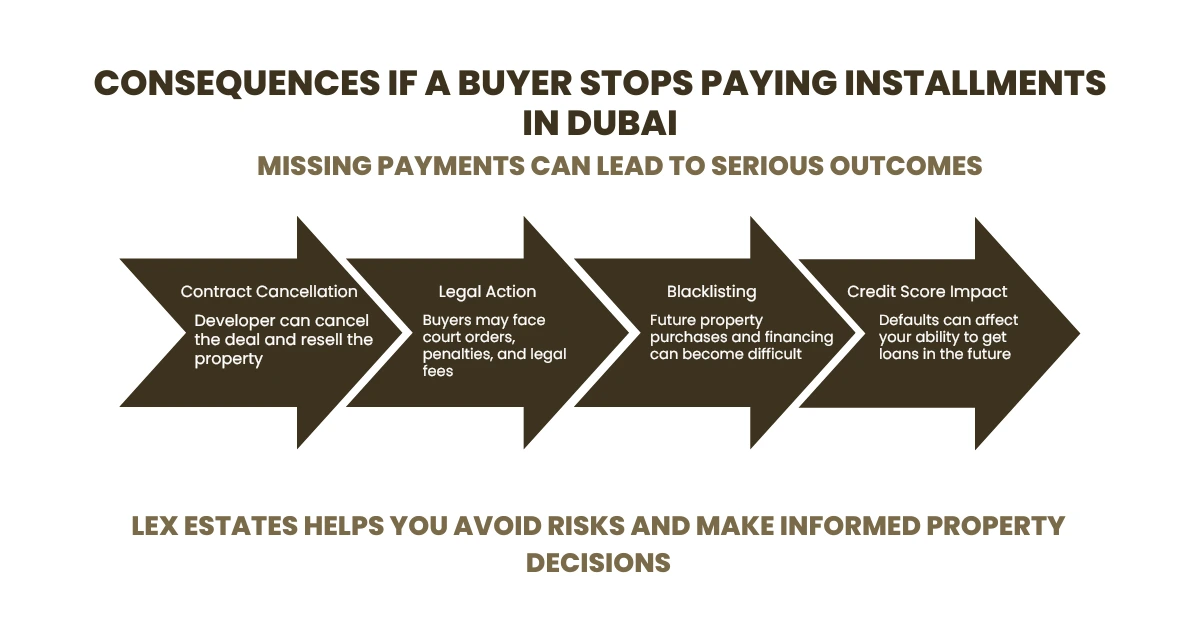
Beyond losing paid installments, buyers face a cascade of additional consequences:
Contract cancellation and resale
If the buyer fails to meet their contractual obligations and does not respond to notices, the off-plan property agreement can be legally cancelled and the property resold by the developer.
Legal action and court judgments:
Developers have the right to pursue legal action against buyers failing to pay installments, to recover outstanding payments. Legal proceedings may result in court judgments ordering buyers to pay the outstanding amounts, along with additional penalties and legal fees.
Blacklisting:
Developers may blacklist the defaulting buyers. This makes a defaulting buyer’s future real estate transactions in Dubai challenging, stopping them from securing financing for future purchases.
Credit Score Damage:
Defaulting on off-plan property payments can negatively impact the buyer’s credit score, affecting their ability to secure loans or credit facilities from financial institutions in the future.
What Should You Do If You Can’t Keep Up With Payments?
Stopping payments without communicating is the single worst thing a buyer can do. Here is what to do instead, in order of priority:
1. Contact The Developer Immediately
Many developers prefer renegotiation over cancellation because they want to complete and sell their projects smoothly. Options may include extending your payment plan, rescheduling missed installments, or switching to a smaller unit with lower payments. Acting quickly improves your chances of finding a solution.
2. Use the DLD’s 30-day mediation window
Do not ignore the DLD notice. This 30-day period is your legal right to negotiate or settle. Engaging during this time period significantly reduces the risk of contract cancellation.
3. Explore a resale or transfer
If you can no longer afford the property, you may be able to sell your off-plan unit or transfer the SPA to another buyer, subject to developer approval. This allows you to recover some of your investment rather than losing it to cancellation penalties.
4. File a complaint with RERA
If negotiations fail, you still have legal options: file a complaint with RERA, which often mediates between buyers and developers, or take the matter to the Dubai Courts.
Can a Buyer Challenge the Developer’s Decision?
Yes. The rules and procedures explained in Dubai Law do not stop the buyer from having recourse to courts or bringing the matter in front of authorities to get relaxations. If you believe the developer has acted wrongly, you have the right to file a case at the Rental Disputes Centre or pursue arbitration.
Lex Estate: Don’t Lose Your Investment to a Missed Payment
One missed installment should never cost you everything. At Lex Estate, we work with off-plan investors across Dubai to protect their investments. Whether that means negotiating with developers, exploring resale options, or identifying the right property, we do all. If you want to invest in off-plan property, or in buying, selling or renting your property in Dubai, speak to an expert at Lex Estates today.
Want to know which documents you need to buy property in Dubai and why they matter? This guide explains everything you should prepare.
Not sure about the Process of Buying Off-Plan Property? This guide explains all.
Frequently Asked Questions
What happens if I miss a payment installment in Dubai?
Missing a single installment triggers a formal process. Most developers will send a payment reminder first. After continued non-payment, the developer has the right to report the case to the DLD and RERA. The DLD then issues a 30-day notice allowing you to pay or negotiate. Act immediately, do not wait for a second notice.
Can a developer keep all my money if I stop paying?
It depends on construction progress. If the project is above 80% complete, the developer may retain all paid amounts and demand the balance from the buyer or sell the property through auction to recover the balance. Between 60% to 80% completion, developers can cancel your contract but keep up to 40% of the property’s value as compensation. If the construction is below 60%, developers can terminate the contract and retain up to 25% of the property value. If the construction has not been started yet without violation from the developer, it can retain 30% of the payment made by the buyer. In all, Developers can impose additional penalties for violations in certain circumstances defined in the SPA, which is why reading your SPA carefully before signing is critical.
Can I get a refund if I can no longer afford the property?
Partial refunds are possible depending on the construction stage. Depending on the percentage of completion, the buyer may or may not be entitled to receive a portion of the money paid to the developer if they are unable to pay all installments. Engaging the DLD’s mediation process gives you the best chance of recovering part of your investment.
Can the developer sell my unit without my permission?
Yes. If you stop paying and the project is nearly complete, the developer may seek approval to sell your unit at public auction. This allows them to recover costs. You may lose your down payment and installments, but the procedure ensures transparency and compliance with Dubai law.