
Joint ownership with unequal shares is allowed in Dubai. You can co-own a real estate property with equal or unequal shares (e.g. 70% to 30% or even less), depending on how much you can afford. This helps you to invest in more expensive and valuable properties and get better returns on the investments. However, before you invest, you must know about the rules and regulations for jointly owned property in Dubai so that you can avoid disputes, fines, and legal issues later on.
What Is Joint Ownership With Equal or Unequal Shares?
Joint ownership with equal or unequal shares means two or more people own a property together, each holding equal or a different percentage, like 60% and 40%. These shares come from money put in or what they agreed on.
The percentages get written clearly in the legal title. Profits, costs, and responsibilities match each person’s share. It’s common for couples, families, investors, or partners who invest differently.
The laws allow up to 4 people to own a single property. In case the investors are more than 4, then a legal structure such as a Foundation or SPV, or limited company can be created with more than 4 shareholders and such an entity can own the property.
Types of Jointly Owned Properties in Dubai
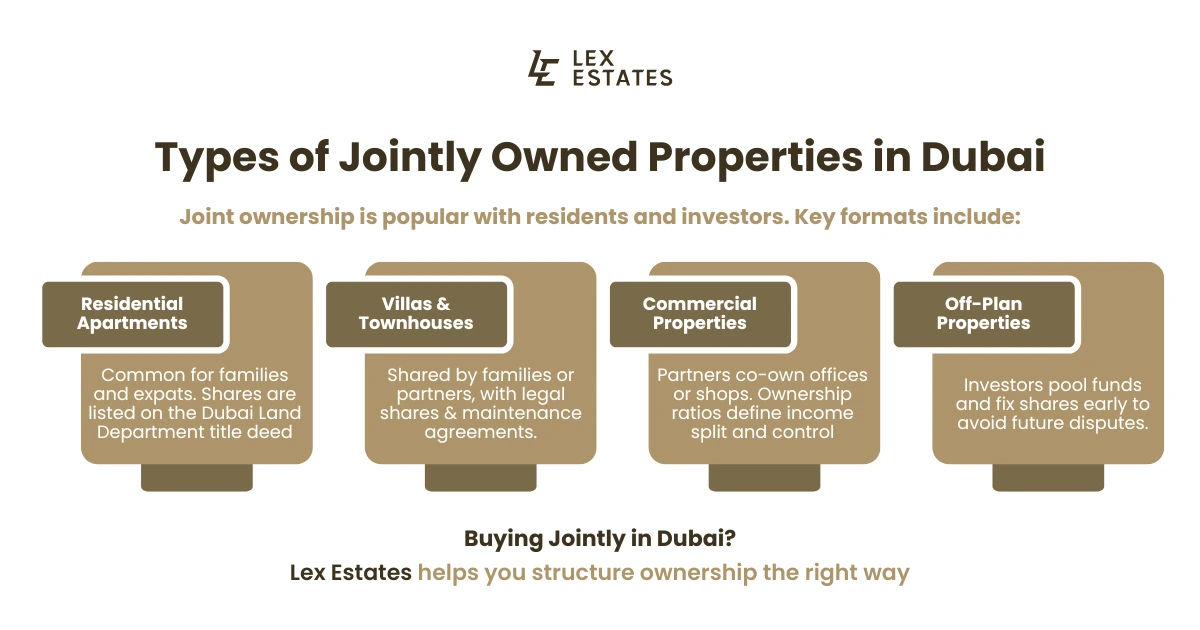
Joint ownership is common in Dubai for both residents and investors. Here are the main types and how they work.
Joint Ownership in Residential Apartments
This is the most common for expats and families buying apartments together. Ownership percentages are clearly listed on the DLD title deed based on each person’s contribution, and a joint declaration adds extra legal transparency.
Villas & Townhouses Under Joint Ownership
Families, relatives, or business partners often share villas and townhouses in luxury areas. Shares are registered legally, and private agreements set out maintenance duties to prevent future arguments.
Commercial Properties With Multiple Owners
Business partners typically co-own commercial spaces like offices or shops. The ownership ratio decides how rental income is split and who has more say in decisions, so a clear legal structure is key for leasing and resale.
Joint Ownership of Off-Plan Properties
Investors often pool money for off-plan projects and agree on shares before completion. Percentages get recorded in sales and registration papers, which helps avoid problems at handover and makes resale or exit easier.
Legal Rules for Joint Property Ownership in Dubai
Joint property ownership in Dubai follows strict property laws to keep things fair and clear for everyone involved. The Dubai Land Department (DLD) registers all deals and records exact ownership percentages on the title deed.
Non-GCC nationals can co-own but only in approved freehold areas. All mortgages, loans, and liens must be disclosed. Major decisions such as sale, mortgage, or transfer require consent from all co-owners unless a legally registered agreement or power of attorney states otherwise.
How to Set Up Joint Property Ownership in Dubai
Setting up joint property ownership in Dubai requires proper planning with legal advisors, banks, and the Dubai Land Department (DLD).
- First, settle on the percentages at which each party will own, and this ought to be documented on the title deed.
- Prepare an official joint ownership declaration that meets DLD rules.
- If a mortgage is involved, get bank approval early and follow their payment procedures.
- Arrange a Power of Attorney if someone cannot attend in person. Use real estate consultants for guidance to avoid mistakes.
- Finally complete registration with the DLD for a smooth and legal title. This works for apartments, villas, or commercial properties.
Managing Joint Ownership: Process and Owner Responsibilities in Dubai
The concept of joint real estate ownership in Dubai needs to maintain clear-cut procedures and shared responsibilities to ensure that everything runs smoothly. Here are the key areas.
Power of Attorney for Absent Co-Owners
A Power of Attorney is used when a co-owner cannot come to Dubai to sign. It must be notarized and legally valid to let a representative handle registration or title transfer on their behalf.
Payment and Title Deed Registration
Payments are structured according to the ownership agreement and financing arrangement, and may be made individually or through approved banking channels. The DLD updates the title deed with all names and records the percentages officially.
Mortgage Approval and Banking Rules
When the property has a bank loan, all co-owners need bank approval. Lenders may require joint guarantors, and the ownership structure must follow the bank’s compliance rules.
Shared Financial and Maintenance Duties
All owners share responsibility for property upkeep, including repairs, utilities, and service charges. Costs are divided according to ownership percentages to maintain the property’s value over time.
Mortgage and Repayment Obligations
In most cases, banks require co-owners to share liability for loan repayments, depending on the mortgage structure and bank terms. Missed payments impact all owners, so good coordination and financial discipline are needed to avoid problems.
Decision-Making and Property Use
Major decisions like renovations, leasing, or changes in usage require agreement from all co-owners. This prevents anyone from acting alone and keeps the property managed fairly.
Communication and Dispute Resolution
Open communication is key to handling financial matters and other issues. Disputes are best resolved through mediation or legal advice to maintain good relations among owners.
Taxes and Fees for Joint Property Ownership in Dubai
Dubai does not impose property ownership or capital gains taxes; however, standard registration fees, service charges, and applicable VAT still apply.
- Property transfer charge: 4% of the agreed purchase value (paid to DLD)
- Registration through the trustee office: Trustee registration fees are typically AED 2,000 or AED 4,000, depending on property value, plus VAT.
- Developer clearance (NOC) fee: It normally varies between AED 500 and AED 5,000.
- Registration of mortgage: 0.25% of the loan approved.
Legally Co-own a Property In Dubai With Lex Estates
Joint ownership with unequal shares in Dubai is allowed by the government. Both owners can have different shares, such as 70% or 30%, depending on how much they can afford. There is no tax on jointly-owned properties in Dubai, just like every other real estate.
If you want to co-own a property or sell it by navigating all the rules and regulations, let Lex Estates’ expert real estate agents help you out. We’ll ensure all the laws are followed, and you get the best price for your property if you’re selling it, and get an affordable ownership if you’re buying it.
FAQS
What is joint ownership of property in Dubai?
Joint ownership in Dubai means two or more people share a property with equal or unequal shares. The Dubai Land Department records the exact percentages on the title deed.
How many people can own one property in Dubai?
Up to 4 people can own one property jointly. More than 4 investors can register a legal entity to own the property through the legal entity.
What is the rule of inheritance in case of joint owners?
If an owner dies without a UAE-registered will, Islamic inheritance rules may apply. Non-Muslim owners can override this by registering a valid will in Dubai.
What are the requirements for a special power of attorney in Dubai?
A special power of attorney must be notarized and attested by the UAE embassy if made abroad and legalized by the Ministry of Foreign Affairs. It must specify property powers and be registered with the DLD for real estate use.