When one co-owner of a jointly owned property dies in the UAE, the surviving owner does not automatically inherit the deceased’s share, even if they are a spouse.
Unlike many Western jurisdictions that recognise a “right of survivorship,” the UAE follows a distinct legal framework under which the deceased’s share is treated as part of their estate, subject to inheritance laws and, in many cases, frozen by local courts until the matter is legally resolved.
Understanding joint ownership & death of an owner is critical to protect your investment, your family, and your future in the UAE real estate market.
Does Property Automatically Transfer to the Surviving Owner?
No. In the UAE, joint ownership of property does not automatically transfer to the surviving co-owner upon the death of another owner. Unlike in some Commonwealth jurisdictions, the UAE does not practice the “right of survivorship,” meaning the local courts will make the final decisions on how the deceased’s share is distributed.
This applies whether the property is owned by spouses, business partners, siblings, or friends. The share of the deceased becomes part of their estate and is subject to either Sharia inheritance law or, for non-Muslim expatriates, the laws of their home country, but only if a registered will is in place. Without a will, the default in UAE courts is Sharia law, regardless of the co-owner’s nationality or religion.
The Two Types of Joint Ownership, and Why It Matters at Death
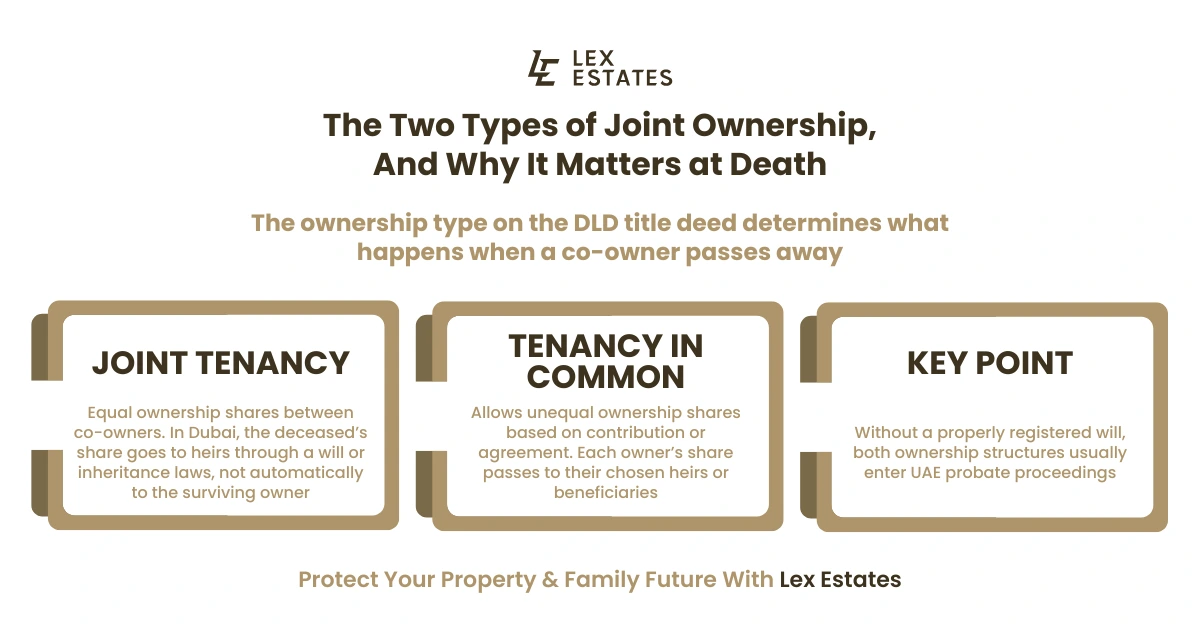
The type of joint ownership registered on the Dubai Land Department (DLD) title deed is the single most important factor determining what happens when one owner dies. Dubai recognizes two primary types: joint tenancy, which involves equal ownership shares, and tenancy in common, which allows co-owners to hold unequal shares based on individual contributions or agreed percentages.
In theory, joint tenancy carries a right of survivorship, but critically, in Dubai, the deceased’s share passes to their heirs according to their will or Islamic inheritance laws, not automatically to surviving co-owners, as it would in some Western countries.
Under tenancy in common, each owner’s share can be passed on to their heirs or beneficiaries as per their will. In both structures, the outcome at death is largely the same without a properly registered will: the estate enters UAE probate proceedings.
Joint ownership & death of an owner: What Happens When One Owner Dies
The immediate legal consequence of a co-owner’s death in the UAE is asset freezing. The death of an individual in the UAE often leads to the immediate freezing of bank accounts and assets, regardless of whether they are jointly owned.
This means the surviving co-owner may be unable to sell, mortgage, or even access the jointly owned property until the court resolves the inheritance matter. The heirs cannot deal with the property until heirship is proven, and the deed cannot be transferred or sold until the court issues the relevant order.
The first required legal step is applying for a Heirship Certificate at the Personal Status Court, after which the Dubai Land Department (DLD) will process the transfer of the deceased’s share to the confirmed heirs. This process can stretch over several months and involve high legal costs if not planned for in advance.
What Happens to a Jointly Owned Mortgaged Property?
When one co-owner of a mortgaged property dies in the UAE, the financial obligation does not disappear; it transfers. If the inherited property has an outstanding mortgage, the beneficiaries typically inherit the debt along with the asset.
The surviving co-owner remains liable for the mortgage, while the deceased’s heirs inherit both the equity and the debt liability attached to the deceased’s share. Many UAE lenders require mortgage life insurance as a condition of the loan, which, if properly in place, would clear the outstanding loan upon the borrower’s death.
However, this is not always guaranteed, and co-owners should confirm the specific terms of their mortgage agreement in advance. In cases where no insurance exists, and heirs cannot service the debt, the property may ultimately need to be sold to settle outstanding liabilities, leaving the surviving co-owner without the asset they had invested in.
The Step-by-Step Legal Process After a Co-Owner Dies in the UAE
Navigating the death of a joint property owner in the UAE involves a structured but often lengthy legal process.
- The first step is obtaining a Heirship Certificate from the Personal Status Court, which officially confirms who the legal heirs of the deceased are.
- All assets tied to the deceased, including the jointly owned property, remain frozen during this period.
- All assets and liabilities of the deceased within the UAE are identified, liabilities are settled from the estate, and once the succession order is issued, assets are distributed to the heirs according to the will or applicable law.
- For real estate specifically, the title deed is transferred to the names of the heirs at the Dubai Land Department upon presentation of a court order.
- If there is a registered will, this process is significantly faster and more predictable.
- If there is no will, the process can involve multiple court hearings, translations of foreign documents, and extended timelines, often six months to over a year.
How Joint Owners Can Protect Each Other
The most important thing joint property owners in the UAE can do is plan before a death occurs, not after. Registering a will with the DIFC Wills Service Centre or the Abu Dhabi Judicial Department is the single most impactful step any co-owner can take.
Beyond a will, co-owners should have a legally drafted co-ownership agreement that clearly outlines what happens to each party’s share in the event of death, incapacity, or a desire to exit.
Co-owners should specify succession plans in their co-ownership and estate planning documents to avoid potential disputes upon an owner’s death. Getting professional help can secure your family in case of any sudden death.
For high-value properties or those owned through business partnerships, a DIFC Foundation can also serve as a succession planning tool, holding the property in a structured manner that bypasses standard probate entirely.
Lex Estates: Handle Joint Ownership & Death of an Owner
Joint ownership & death of an owner in the UAE carries legal responsibilities that don’t end at purchase; they peak at death. Without the right will, structure, or legal advice in place, surviving co-owners can find themselves frozen out of a property they helped build. At Lex Estates, we offer real estate expertise and assist with structuring your property ownership in cooperation with our legal partners to help you protect your assets in Dubai/UAE. Contact us today for a confidential consultation in case you need to connect with professionals or buy or sell a property in Dubai.
Frequently Asked Questions
Does a surviving spouse automatically inherit jointly owned property in the UAE?
No. In the UAE, a surviving spouse does not automatically inherit their deceased spouse’s share of jointly owned property. Without a registered will, the deceased’s share is distributed according to Sharia inheritance law, which allocates fixed shares to multiple heirs, including children and parents, meaning the spouse may receive only a portion of the deceased’s share.
What happens to jointly owned property in Dubai when one owner dies?
When one owner of jointly owned property dies in Dubai, their share is frozen immediately and becomes part of their estate. The surviving co-owner retains their own registered share but cannot deal with the deceased’s share until the court issues an heirship certificate and a probate order. The deceased’s share is then transferred to their legal heirs as determined by the applicable inheritance law.
Can a DIFC protect my jointly owned property in Dubai?
Yes. A DIFC-registered will is one of the most effective ways to protect jointly owned property in Dubai. It allows non-Muslim expatriates to specify that their share of a jointly owned property passes to the person of their choice, such as a surviving co-owner, rather than being distributed under Sharia inheritance law. It also helps speed up the probate process and prevents asset freezing from becoming a prolonged crisis.
Is there a right of survivorship for jointly owned property in Dubai?
Unlike countries such as the UK or Australia, the UAE does not recognize an automatic right of survivorship for jointly owned real estate. The deceased co-owner’s share does not pass automatically to surviving co-owners; it is subject to UAE inheritance laws or the terms of a registered will.
What is the first legal step after a joint owner dies in the UAE?
The first legal step is applying for a Heirship Certificate at the Personal Status Court. This document officially confirms who the deceased’s legal heirs are. Without it, no transfer of the deceased’s property share can be processed at the Dubai Land Department, and all related assets remain legally frozen.