What if you want to reclaim your rental property for personal use? Evicting a tenant for personal use in Dubai is legal according to the rules of RERA and DLD. However, you need to do it carefully, step by step, following all the requirements and the rules to avoid penalties and legal disputes. Want to learn how to evict a tenant for personal use in Dubai legally? In this post, Lex Estates real estate agents explain to you how to do that.
Is Evicting a Tenant for Personal Use In Dubai Allowed?
Yes, it’s allowed to evict a tenant for personal use as per the Dubai Tenancy Law 26 of 2007 and Law 33 of 2008. However, the landlord must give the eviction notice 12 months in advance. The personal use must be valid, such as for the owner or a first-degree relative, to move into the property. After regaining possession, the property cannot be rented out for at least 2 years (residential) or 3 years (commercial), which is called a “Cool-Off” period.
Dubai Personal-Use Eviction Rules and Tenant Protections
These are the rules for the personal use tenancy eviction in Dubai that the tenant and the landlord must be aware of.
Notice Requirement for Personal Use
Landlords must give an eviction notice to the tenant that clearly mentions the reasons for the eviction. The notice must be notarized at a notary’s office and easy to understand so both parties can agree. The notice period begins when the tenant receives it, not when it is stamped and filed.
Restrictions on Re-Renting
The property cannot be rented out immediately after eviction for personal use. The landlord has to use the property for personal use until the cool-off period to prevent false claims and avoid legal issues.
Rules in Other Emirates
The rules for personal-use eviction in Dubai vary by emirate, as shown below:
- Sharjah: In Sharjah, most residential evictions have been restricted for over 3 years to protect tenants.
- Abu Dhabi: In Abu Dhabi, personal-use evictions are permitted with only 2 months’ notice upon lease renewal, rather than 12 months.
Step-By-Step Guide to Writing a Personal-Use Eviction Notice
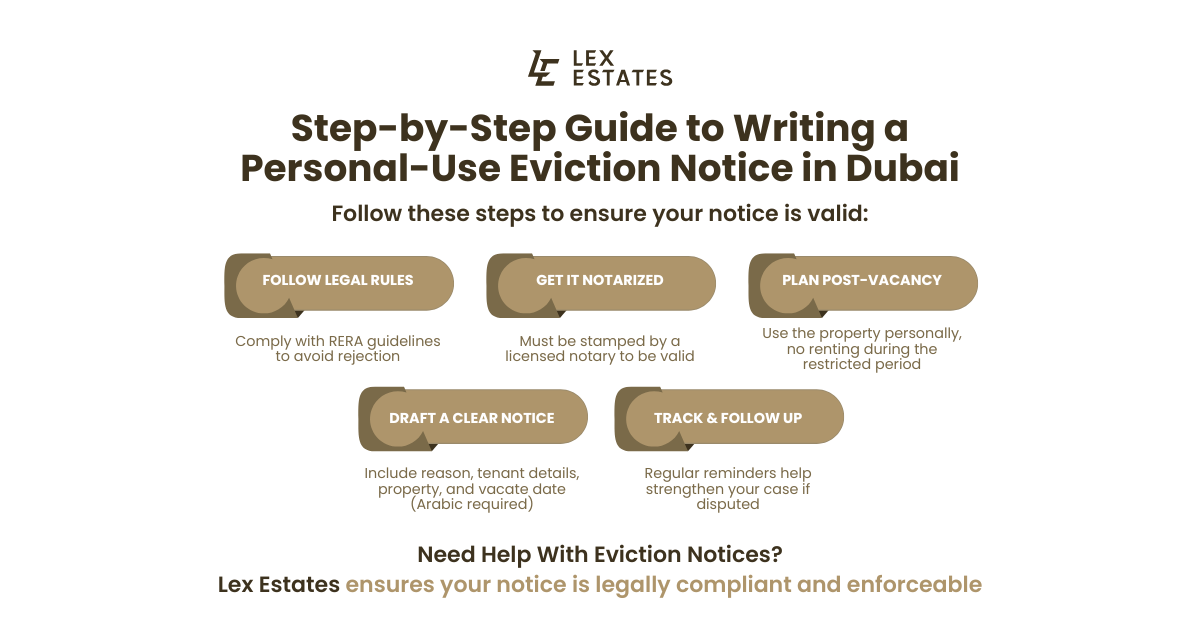
Writing a personal-use eviction notice in Dubai must follow RERA rules. One small error could invalidate the notice or lead to case dismissal at the Rental Dispute Settlement Centre. The following are the steps to write an eviction notice that is valid and follows all the rules.
1. Follow Legal Requirements
Ensure that all the legal procedures are performed properly not to get into delays or get refused at the Rental Dispute Settlement Centre. Omitting regulations or using a standard template can render the notice invalid. Follow RERA guidelines properly, as if you don’t, your notice won’t be valid.
2. Draft a Specific Notice
Draft a clear, specific notice for personal-use eviction; avoid general forms, as they are often rejected. Include all required details, such as the exact reason, tenant’s name, property address, and vacate date. Being direct and specific strengthens your claim and reduces the chances of challenges. The notice has to be in the Arabic language, but can include a legally translated English version for easier understanding by non-Arabic speakers.
3. Get the Notice Notarized
Book an appointment with a licensed notary early to have the notice stamped and registered. Unnotarized notices are always rejected by the Rental Dispute Settlement Centre. This mandatory step proves the document is real and protects your case if the tenant disputes it. Here is the step-by-step guide on Online Notarization of Eviction Notices in Dubai.
4. Prepare for Vacancy
After the tenant vacates, you can move into the property personally or by a first-degree relative. Nevertheless, you can not rent it out to third parties until the expiry of the cool-off period. Budget carefully to avoid being caught off guard by lost rent. Good financial planning keeps you safe during this time.
5. Follow-Up and Track
Although it is not legally required, you may set reminders to follow up with the tenant at 90, 60, and 30 days prior to the eviction date. Consistent follow-up demonstrates good faith if the tenant fails to vacate. Tracking everything strengthens your position if the case goes to the Rental Dispute Settlement Centre.
Tenant Actions After Receiving a Personal-Use Eviction Notice
As a tenant receiving a personal-use eviction notice, here are the steps to take:
Check the Notice Stamp
First, check if the notice is officially stamped and notarized. If not, the notice period does not start until it is notarized.
Confirm Owner’s Intent
Politely ask the landlord when they plan to move in. This helps determine if the claim is genuine or a false claim for a rent increase.
Keep a Record of Communications
Keep records of all calls, emails, and relevant bills. Also, save DEWA receipts and Ejari documents to build a timeline for potential disputes.
Consider Early RDSC Action
If you suspect anything wrong, file a pre-emptive grievance at the RDSC. This allows action without waiting a full year.
Best Practices to Avoid Court Disputes
Follow these best practices to avoid court disputes between a landlord and tenant.
For Landlords
- Offer goodwill gestures: Offer a short rent-free period to show fairness. It reduces the tensions between them.
- Document renovations: If evicting for improvements, take time-stamped photos and records as strong evidence if challenged.
For Tenants
- Negotiate early: Request a short paid extension to avoid legal fees.
- Check rent caps: Use the RERA rent calculator to check if the landlord is trying to raise rent illegally under the guise of personal-use eviction.
Need to Evict a Tenant for Personal Use? Lex Estates Has You Covered
Evicting a tenant for personal use in Dubai is legally possible according to the Dubai tenancy laws. You must provide at least 12 months’ notice with a clear reason and timeline. You cannot re-rent the property immediately, as that invalidates the personal-use claim. The notice must be notarized for validity.
If you need to evict tenants, buy, sell, or rent property in Dubai, contact Lex Estates today. Our experienced real estate agents will assist with all aspects of your deal, ensuring compliance with laws.
Want to know about Procedure Of Evicting a Tenant in Dubai? Read our full blog here.
Curious about Valid Legal Grounds for Eviction: Laws, Notices, and Tenant Rights? Read our full blog here.
Want to know about Dubai Rental Laws? Read our full blog Dubai Rental Laws Explained: Tenancy Rights, Eviction & Disputes.
FAQS
Can a landlord evict a tenant in Dubai?
Yes, but only for valid reasons under RERA law, such as non-payment of rent, property damage, or personal use. The process must follow strict legal steps, or it will be rejected.
How long does it take to evict a tenant in Dubai?
Evictions in normal cases require 12 months of notice, and if the tenant does not vacate voluntarily, it typically takes an additional 3-6 months to get the judgment from RDSC and enforce it. Delays from disputes, incorrect notices, or court backlogs can extend it to 12 months or more.
How to evict an illegal occupier?
File a case at the Rental Dispute Settlement Centre with proof of ownership and lack of a valid lease. The court will issue an eviction order, enforceable by police if needed.