In Dubai, a landlord cannot evict a tenant without a legally recognized basis. Grounds for eviction can be grouped into two: eviction for breach or eviction in cases where there is no breach. The valid grounds for eviction for breach include unauthorized use of the property, serious damage or dangerous structural alterations, breach of applicable regulations, and a certified risk of building collapse. The eviction where there is no breach includes property sale, recovering the property for personal use, major maintenance, and demolition or reconstruction. Without one of these grounds, any attempt at eviction is unlawful and can expose the landlord to legal disputes and significant financial penalties.
This article covers tenant eviction in Dubai in detail, as per the rules established by the Dubai Land Department (DLD) and Real Estate Regulatory Agency (RERA), specifically Law No. 26 of 2007 as amended by Law No. 33 of 2008.
Valid Legal Grounds for Eviction
Under Law No. 26 of 2007 (as amended by Law No. 33 of 2008), the following are recognized as valid legal grounds for eviction in Dubai.
Eviction for Breach of Tenancy Contract or Laws:
1. Non-Payment of Rent
Under Article 25(1) of Law No. 26 of 2007, a landlord may initiate eviction proceedings if a tenant fails to pay rent, in full or in part, within 30 days of receiving a written payment demand. This is one of the most commonly invoked grounds for eviction in Dubai and requires a formal, documented notice before any legal action is taken.
2. Subleasing Without the Landlord’s Written Consent
Article 25(1)(b) prohibits tenants from subletting the property, whether in whole or in part, without obtaining the landlord’s prior written permission. If a tenant violates this rule, the landlord may seek eviction of both the original tenant and any subtenant. In such cases, the landlord may also claim compensation for any losses suffered.
3. Illegal or Immoral Use of the Property
Under Article 25(1)(c), if a tenant uses the property for activities that violate the law or infringe public order and morality, the landlord is entitled to pursue eviction. This ground applies regardless of the type of property and does not require a prior notice period.
4. Commercial Property Left Unoccupied
According to Article 25(1)(d), a landlord may issue an eviction notice if a commercial property remains vacant for 30 consecutive days or 90 non-consecutive days within a single year, unless the lease agreement explicitly provides otherwise. This provision protects landlords from prolonged, unproductive tenancies.
5. Serious Property Damage or Dangerous Structural Changes
Article 25(1)(e) permits eviction when a tenant intentionally or negligently causes significant damage to the property, or makes alterations that compromise the structural integrity of the building in a manner that cannot be readily restored. The damage must be substantial and well-documented to support an eviction claim.
6. Unauthorized Use or Regulatory Violations
A tenant may be evicted if the property is being used in a manner inconsistent with the purpose stated in the lease agreement. This includes violations of planning regulations, building codes, or land use restrictions. For example, operating a commercial business in a residential unit without authorization would fall under this ground.
8. Failure to Meet Legal or Lease Obligations
Under Article 25(1)(h), if a tenant neglects legal duties or fails to comply with the terms of the lease, the landlord must first issue a formal written notice granting the tenant 30 days to remedy the breach. If the tenant does not resolve the issue within that period, the eviction becomes legally valid.
Eviction Where There Is No Breach:
1. Property Sale
If the owner wants to sell their property, the law allows them to evict the tenant by serving a 12-month notice. The intention behind it has to be genuine and legally provable to avoid legal disputes. If the landlord rents out the unit to a different tenant without selling it, the previous tenant may dispute it and demand compensation, which can delay the eviction process.
2. Landlord’s Need for Personal Use
Under Article 25(2), a landlord may reclaim the property for personal use or for a first-degree relative, provided a formal 12-month written notice is served via notary public or registered mail. The landlord must not own another suitable property in the same area, and the unit cannot be re-rented for at least 2 years (residential) or 3 years (non-residential) following the eviction.
3. Major Repair or Maintenance Work
If the property requires a major repair or maintenance work which can not be carried out while the property is occupied by the tenant, the law allows the landlord to evict the tenant by serving 12-months advance notice. This type of work typically requires official authorization or a report that is recognized by the municipality. Minor repairs are not considered a valid reason for eviction.
4. Risk of Building Collapse or Demolition Order
When a property is deemed structurally unsafe, eviction may be carried out in the interest of public safety. This ground requires a technical report formally approved by Dubai Municipality confirming that the building poses a genuine risk of collapse. The eviction in such cases is intended to protect both the occupants and the surrounding residents.
What Landlords Are Not Permitted to Do Under Dubai Eviction Law
Dubai rental law places clear restrictions on landlord conduct. The following actions are prohibited:
Eviction Without a Valid Legal Basis
A landlord cannot evict a tenant without a recognized legal ground for eviction. Any eviction notice issued must clearly state the basis for the eviction. Proceeding without a valid legal reason constitutes an illegal eviction under Dubai law and may result in financial penalties for the property owner.
Re-Renting Immediately After a Personal Use or Renovation Eviction
If a landlord evicts a tenant citing personal use or renovation as the reason, re-renting the property immediately afterwards is not permitted. Residential properties must remain off the rental market for at least two years, while non-residential properties require a minimum of three years before being re-let. This restriction is designed to prevent landlords from misusing these eviction grounds as a pretext for replacing tenants.
Increasing Rent Too Early or Excessively
Landlords cannot unilaterally increase rent within the first two years of a tenancy agreement. Any rent increase during this period requires mutual consent from both parties. Furthermore, all rent adjustments must align with the Dubai Rental Index to prevent unreasonable or disproportionate increases.
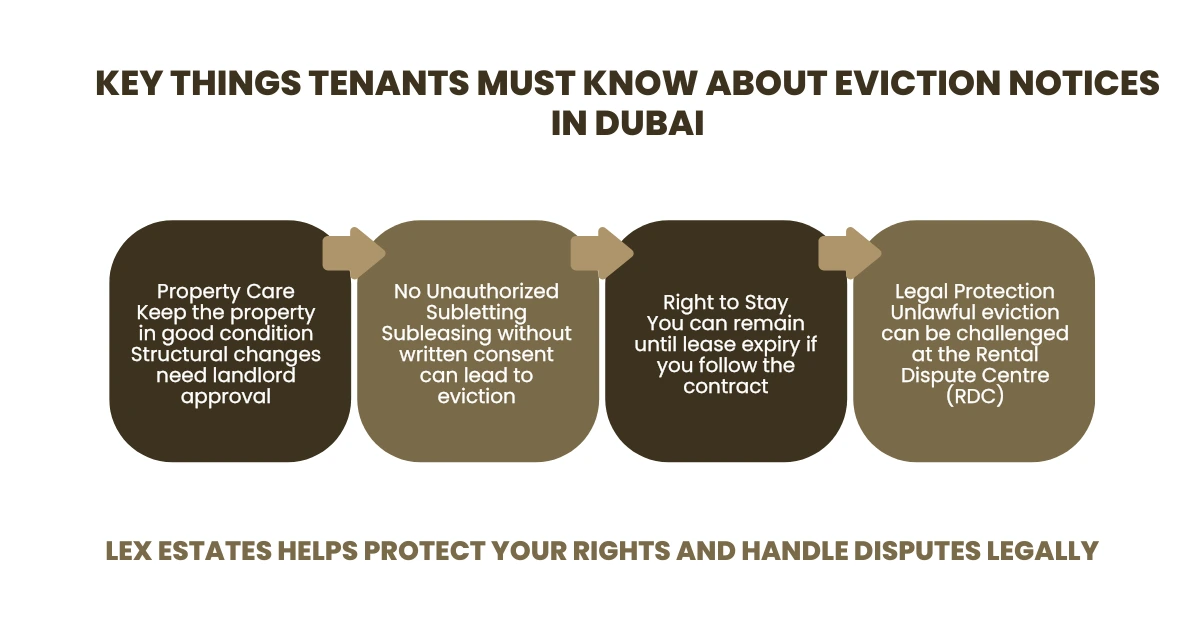
Key Things Tenants Must Know About Eviction Notices in Dubai
Property Care and Structural Modifications
Tenants are responsible for keeping the property in good condition throughout the duration of the tenancy. Significant structural modifications, such as alterations to walls or room layouts, are not permitted without the landlord’s written approval. If a landlord attempts an unlawful eviction, tenants may seek legal recourse under the updated provisions of Law No. 26 of 2007.
Subleasing Rules
Subletting the property, or any part of it, is not permitted without the landlord’s explicit written consent. Doing so without permission gives the landlord grounds to pursue legal action, including eviction proceedings against both the original tenant and any subtenant.
Right to Remain Until Lease Expiry
As long as a tenant complies with the terms of the lease and applicable laws, they have the legal right to remain in the property until the contract expires. No landlord can compel a tenant to vacate without a recognized legal reason. Any such attempt may be challenged at the Rental Dispute Centre (RDC).
Protect Your Property Rights – Speak to a Lex Estates Agent
Valid legal grounds for eviction in Dubai include non-payment of rent, subleasing without consent, illegal or immoral use of the property, planning or regulatory violations, serious structural damage, commercial vacancy, risk of building collapse, and breach of legal or contractual obligations. Without one of these recognized grounds, a landlord cannot lawfully evict a tenant in Dubai.
If you are looking to buy, sell, or rent property or resolve an eviction matter in Dubai in full compliance with RERA and DLD regulations, contact Lex Estates today. Our experienced real estate professionals are here to guide you through every step of the process, ensuring your transaction closes smoothly and without legal complications.
Want to learn about Tenancy Rights, Eviction & Disputes? Read out our full blog Dubai Rental Laws Explained: Tenancy Rights, Eviction & Disputes.
Frequently Asked Questions
What are the rules for eviction in Dubai?
A landlord must issue a 1-month or 12-months notarized written eviction notice based on a valid legal ground. The notice must clearly state the reason for eviction and be delivered via registered mail or through a notary public, as required by Dubai rental law.
What is a valid reason for eviction in Dubai?
Valid reasons include non-payment of rent, subleasing without permission, using the property for illegal purposes, causing serious property damage, or the landlord’s documented need for personal use, or plan to sell the property, provided a 12-month notice has been given in the latter case.
How can a tenant be protected against illegal eviction in Dubai?
A tenant facing an unlawful eviction may file a dispute at the Rental Dispute Centre (RDC), providing evidence of a valid lease agreement, timely rent payments, and compliance with all contractual terms. If the tenant’s case is established, the courts can legally halt the eviction and order appropriate remedies.