
The timeline of eviction process in Dubai varies depending on the complexity of the tenant’s dispute case and the tenant’s response. Usually, the Rental Disputes Centre (RDC) aims to resolve the case within 30 days, ensuring that the landlord gets their property back from the tenant.
However, the timeline may extend if the case is more complex. Let’s learn in detail about the duration of the eviction process in Dubai, what causes the delays, and what you can do to speed it up and free your property sooner.
Timeline of Eviction Process
Although the RDC aims to resolve tenant eviction in Dubai within 30 days after reviewing notices and legal details, the timeline can extend in complex cases. However, when the case is complex, and any dispute is involved between the tenant and the landlord, the process can go from 30 to 60 days or sometimes 3 months.
Reasons For The Delayed Timeline Of the Eviction Process in Dubai
The eviction timeline in Dubai can also get delayed due to not following the correct process of sending the eviction notice, wrong reason mentioned in the eviction notice, refusal by the tenant to vacate, and relying on simple correspondence which may not have any legal force. . For the eviction to be effective, the initial eviction notice has to be done correctly by following the due process prescribed by law.
Eviction Due to Violation of Tenancy Contract and Laws
If the tenant violates any of the terms of the tenancy contract (e.g., non-payment of rent, using the property for illegal purposes, or sub-renting it without the landlord’s consent), the law allows the landlord to serve one month’s notice, during which the tenant can correct the mistake, failing which the landlord can demand eviction with immediate effect. Both the notice of violation and the eviction notice have to be notarized by the local notary and have to be served through an authorized courier company. Not following the legal requirements of serving the notice would delay the eviction process even if the tenant is in breach of the tenancy contract.
If there are no violations by the tenant, then the landlord can ask for eviction only for specific reasons: property sale, using the property for own use, major repair, demolition or reconstruction.
Eviction Due to Property Sale
If the owner wants to sell their property, the law allows them to evict the tenant by sending a 12-month advance legal notice to the tenant. The reason is that some buyers prefer to buy vacant units. The intention behind it has to be genuine and legally provable to avoid legal disputes. If the landlord rents out the unit to a different tenant without selling it, the previous tenant may dispute it and demand compensation, which can delay the eviction process.
Eviction of the Owner or a Close Relative Needs the Home
When the landlord wants to move into the property or intends for their first-degree family members to live in it, the legal ground is personal use. The landlord must prove that they don’t have any other suitable property to live in. If the claim turns out to be false, the tenant can challenge the personal use claim, which can also delay the eviction.
Eviction Due to Major Repair or Maintenance Work
Eviction in Dubai may be demanded if major repairs are planned, and the landlord must prove that the renovation requires the tenant to vacate. This type of work typically requires official authorization or a report that is recognized by the municipality. Minor repairs are not considered a valid reason for eviction. Misusing this reason for eviction may delay the eviction because it can be easily challenged.
Eviction Due to Demolition or Reconstruction
Eviction can be delayed in demolition or reconstruction cases, as the landlord must obtain government approval and prove that the work requires the tenant to vacate. Additionally, a 12-month advance legal notice must be served before eviction can proceed. These requirements take time to complete.
Tips To Speed Up The Timeline of the Eviction Process in Dubai
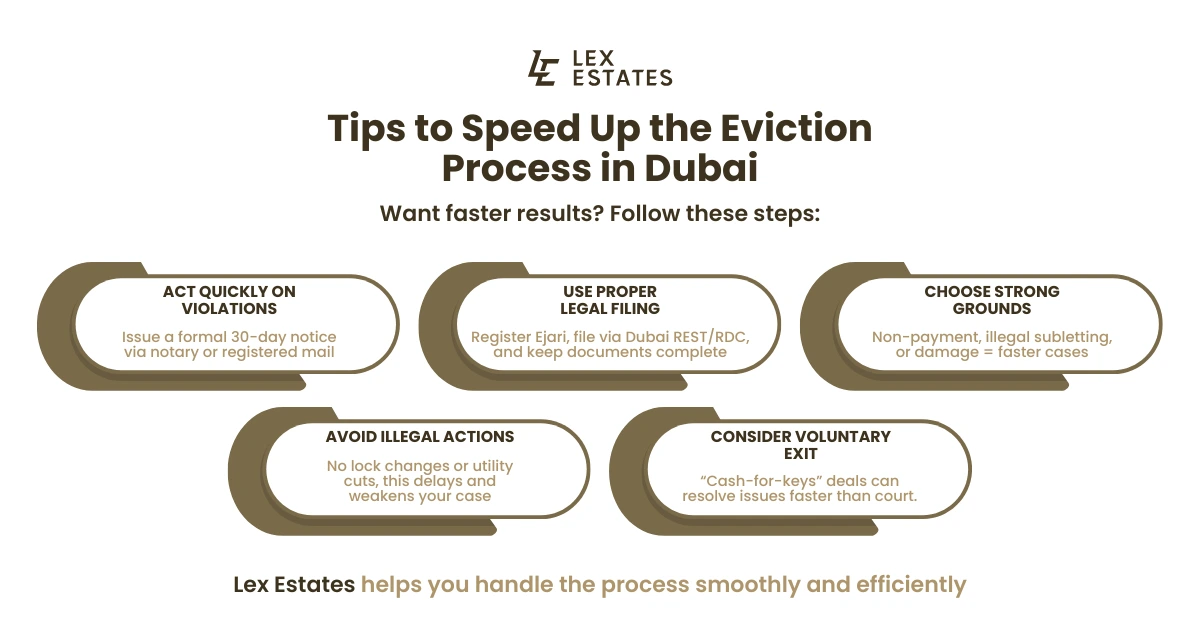
Want to quickly evict the tenants from your property in Dubai? Follow these tips to do that.
Deal Quickly When Contract Violation Happens
If your tenant isn’t paying the rent, subletting illegally, or breaking any rules, don’t wait; write a formal 30-day warning notice stating the reasons and the issues. Submit it to the tenant through the notary public or registered mail.
Use Proper Legal Filing Methods
Register the tenancy contract with Ejari, so your case has strong legal backing. File everything online through the Dubai REST app or the RDC website for quicker processing. Write notices in both English and Arabic to prevent translation delays. Complete and correct paperwork avoids rejection and speeds up hearings.
Focus on Fast-Track Eviction Grounds
Non-payment of rent is the quickest reason for eviction after the 30-day notice. Illegal subletting without permission also allows fast action. Serious misuse or damage to the property supports speedy eviction. Choosing these clear grounds shortens the process compared to weaker reasons.
Don’t Force
Never change locks, cut utilities, or remove tenant belongings. Such unlawful actions undermine your case, which may result in fines or delays. When the case is personal use or sale, always observe the 12-month notice rule. Staying within the law keeps the eviction timeline on track.
Try Voluntary Exit Agreements
Offer the tenant a small cash incentive to leave voluntarily instead of going through court. This cash-for-keys method is often much faster than legal battles. Put the agreement in writing to make it official. Using a lawyer or legal typing service helps avoid mistakes and keeps everything smooth.
Lex Estates: Your Ultimate Solution to Property Deals in Dubai
If you’re having trouble evicting your tenants due to the complex legal disputes and the process, let Lex Estates real estate agents help you connect with the right services or navigate the process. We offer hassle-free buying and selling of property across Dubai and help you get maximum ROI with your property deals. Contact us today for a consultation.
Learn about Dubai Rental Laws Explained: Tenancy Rights, Eviction & Disputes
FAQS
How long does it take to evict a tenant in Dubai?
Evicting a tenant in Dubai usually requires 1 month or 12 months’ notice, depending on the reason for eviction. If the tenant refuses to vacate after the notice, then an eviction case can be opened at RDC, and the process takes 30 to 60 days if the case is straightforward. Paperwork hearings and enforcement add time. Disputes or errors often stretch it to 6 months or more.
What is the minimum time for eviction?
The shortest eviction in Dubai takes about 1-2 months with a strong case, like unpaid rent after a 30-day notice. In case of non-violation by the tenant, the landlord is required to service 12 months notice in advance only for specific reasons like property sale, and if the tenant refuses to vacate after completion of the notice, the eviction process through RDC can take 1-3 months.
What delays the eviction process in Dubai?
Eviction delays come from unregistered Ejari contracts, defective notices, wrong reasoning or timelines, or the tenant’s refusal to vacate. Weak paperwork, court backlogs, or invalid reasons slow everything down. Reasons like personal use or sale need a 12-month notice, adding months. Proper steps from the start keep it faster.