
If you believe that an eviction notice served against you is unfair, legally defective, or does not comply with Dubai’s rental laws, you have the right to contest it. You can file a formal dispute with the Rental Disputes Centre (RDC), which will review the documents and evidence presented by both parties. If your complaint is valid, the RDC can pause the eviction.
In this guide, our experts at Lex Estates have covered everything tenants need to know about contesting eviction notices in Dubai. You will know the grounds on which you can challenge, the documents required, how to track your case, the costs involved, and how long the process typically takes.
Is Contesting an Eviction Notice Allowed in Dubai?
Yes. Under Law No. 26 of 2007 and its amendment, Law No. 33 of 2008, tenants have the legal right to contest an eviction notice if the landlord has not followed the correct legal process or does not have valid grounds for eviction.
A landlord cannot legally evict a tenant who is paying rent on time, complying with the tenancy agreement, maintaining the property, and not subletting without permission.
If the landlord seeks to evict for sale, personal use, demolition, or major renovation, they must serve a 12-month notice. This notice should be notarised and legally served, either through a registered Notary Public or via registered mail. Any failure to meet these requirements gives the tenant grounds to challenge the notice.
Learn more about Valid Legal Grounds for Eviction: Laws, Notices, and Tenant Rights. Read full blog.
How to Contest an Eviction Notice at the RDC
As a tenant, file a contest against an eviction notice in Dubai, which follows a simple process. You can file your case online through the official RDC portal or in person at the RDC Head Office at 10 3rd Street, Riggat Al Buteen, Deira.
Contest an eviction notice by submitting your case details, uploading the required documents, and paying the applicable fees. An RDC typist is available at the centre to assist with formalising and submitting your complaint if needed.
Required Documents
Ensure all documents are complete and accurate, as the quality of your documentation directly affects the outcome of your case. The following documents are required:
- Copy of both the tenant’s and landlord’s of passports or Emirates IDs.
- Title deed of the property.
- Tenant’s passport and visa copy.
- Latest DEWA bill.
- Copies of rent cheques.
- Ejari certificate and registered tenancy contract.
- Rental security deposit receipt.
- Eviction notice copy.
- Any previous written communication between the tenant and the landlord.
- Any other supporting documents relevant to the dispute.
Note: Some documents may need to be translated into Arabic before submission. Contact the RDC in advance to confirm which documents require translation, or arrange translation through the RDC typist at the centre. Submitting fully translated documents from the outset helps avoid delays in processing your case.
How to Check Your Case Status
Whether you filed online or in person, you can track the progress of your case through the official Dubai Land Department (DLD) website. Select the ‘Track Your Case’ option under the RDC tab and enter your case number, case type, and case year to view updates.
If you prefer direct assistance, you can visit the RDC Head Office in Deira and speak with a representative for a status update on your case.
Costs and Charges for Filing a Case at the RDC
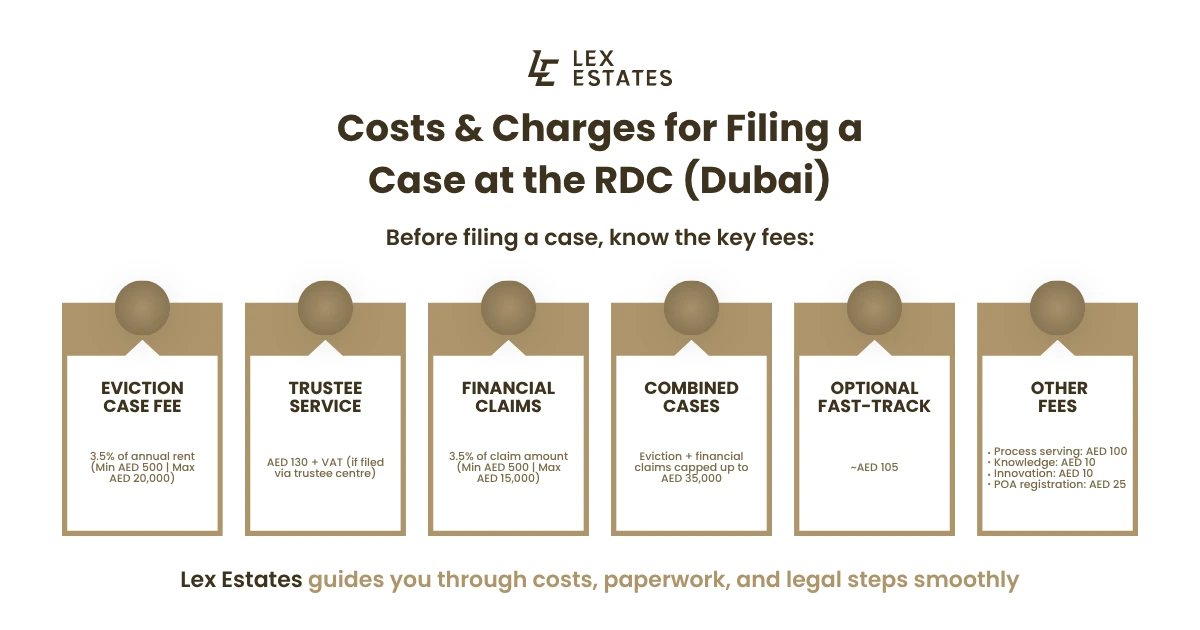
The following are the applicable fees for filing a contested eviction case at the RDC. Since minor fees may be updated periodically, it is advisable to verify the current schedule on the official RDC or DLD website before filing.
- Rental eviction fee: 3.5% of the annual rent, minimum AED 500, maximum AED 20,000.
- Financial claims only: 3.5% of the claimed amount, minimum AED 500, maximum AED 15,000.
- Combined eviction and financial claims: the fee cap may increase to AED 35,000, depending on the scope of the case.
- Real Estate Trustee service charge: AED 130 + VAT (if filing through a trustee centre).
- Fast-track notification service: approximately AED 105 (optional).
- Process serving fee: AED 100.
- Knowledge fee: AED 10.
- Innovation fee: AED 10.
- Power of Attorney registration (if required): AED 25.
Dispute Resolution Timeline at the RDC
The RDC follows a two-stage process when resolving rental disputes.
- Arbitration/Mediation: When a case is filed, the RDC’s Arbitration Department first attempts to broker an amicable settlement between the parties. This stage targets a resolution within approximately 15 days. If both parties reach an agreement, it is recorded and carries the force of a legally enforceable judgment.
- Court Proceedings: If mediation does not result in a settlement, the case proceeds to the First Instance Committee, which targets a ruling within approximately 30 days, though complex cases may take longer. If either party wishes to appeal the judgment, an appeal must be filed within 15 days of the verdict, provided the case value exceeds AED 50,000.
The RDC provides online tools to file cases, upload documents, and track case status, and hearings can be attended remotely through the RDC’s tele-litigation system.
Navigate Your Property Matters in Dubai with Lex Estates
Contesting an eviction notice in Dubai is a well-established legal right under UAE rental law. If you believe the eviction is unjust, the notice is legally defective, or the landlord has not followed the correct process, you can file a case with the RDC by submitting the required documents and details of your dispute.
The RDC will first attempt mediation, targeting a resolution within 15 days. If mediation is unsuccessful, the case moves to court proceedings, which typically target a ruling within 30 days, though timelines may extend depending on the complexity of the case and whether appeals are filed.
Whether you are a tenant navigating an eviction or a landlord looking to manage your property with greater confidence, Lex Estate’s experienced property specialists are here to help. From finding the right tenants to full-service property management and buy-and-sell guidance across Dubai, we ensure your property investment is in the right hands. Contact us today to find out how we can help.
Want to Know more about Dubai Rental Laws? Read our blog, Dubai Rental Laws Explained: Tenancy Rights, Eviction & Disputes.
Frequently Asked Questions
How do I challenge an eviction notice in Dubai?
Check whether the notice complies with Law No. 33 of 2008, verify the reason cited, the notice period, and that it was served through a Notary Public or registered mail. If something is incorrect, file a dispute at the RDC with your Ejari-registered tenancy contract and supporting evidence. A valid challenge can stop or delay the eviction.
Can I legally contest an eviction in Dubai?
Yes. If you are complying with your tenancy agreement and the landlord does not have a valid legal ground for eviction, you can contest the notice at the Rental Disputes Centre. The RDC will review the case and decide based on the Dubai rental law.
What should I do after receiving an eviction notice?
Read the notice carefully and confirm the reason and timeline stated. Verify that it complies with Law No. 33 of 2008. Gather your tenancy contract, Ejari certificate, and all relevant documents. If the notice appears incorrect or unlawful, seek advice or file a case at the Rental Disputes Centre promptly.