Buying property in Dubai involves several legal steps, and one document shapes the entire deal, called Form F (MOU). It acts as the core agreement that records the price, deposit, and commitments between both parties (buyers/sellers). This sale and purchase agreement is commonly known as the Memorandum of Understanding, a document used across major UAE business agreements to confirm terms before anything moves forward. In real estate, the MOU Form F is the version that protects buyers and sellers and starts the transfer process.
This guide, prepared by Lex Estates property advisors, explains the importance of Form F and how this agreement supports a clean handover. You’ll also learn what the document includes and what buyers must double-check before signing.
What Does MOU Mean in Dubai Property Deals?
A Memorandum of Understanding (MOU) in Dubai property deals is the agreement that records the final terms once an offer is accepted. It is known as DLD Contract Form F (MOU), the standard contract issued by the Dubai Land Department (DLD). Signing is completed through the DLD’s “Dubai REST” app. Used mainly in secondary-market sales, it sets the price, payment schedule, payment obligations, transfer date, and responsibilities. This legal agreement also outlines the 10% deposit, penalties for breach, broker’s commission (if any) and follows DLD and RERA rules to keep the transaction aligned and protected.
Importance of Form F (MOU) Property Contract in the UAE
Form F (MOU) plays a central role in every resale property deal because it gives the transaction a clear legal framework before transfer begins. It removes uncertainty in property transactions, locks the agreed terms in place, and creates a structure that both sides must follow under the Dubai Land Department and RERA rules. In a market that moves quickly, this contract offers clarity, accountability, and protection from disputes. Here’s why the memorandum of understanding matters:
- Legal Security: Form F is fully enforceable, giving both sides legal security and stopping attempts to change agreed terms.
- Locks Agreed Terms: The contract secures the agreed price and conditions, preventing changes once signed.
- Prevents Competing Negotiations: It stops sellers from engaging with other potential buyers, ensuring exclusivity.
- Facilitates Next Steps: By finalizing the agreement, it allows the property transfer process to begin confidently and legally.
Enforceability and Consequences!
Before signing Form F, sellers and buyers usually enter into DLD Contract Form A and Form B separately with the broker. Once parties negotiate and agree the terms, Form F is drafted through the DLD system to guide the full transaction. Breaches by either party carry legal consequences, enforceable through Dubai Courts.
Essential Elements of Form F (MOU)
A well-prepared Contract Form F (MOU) ensures both buyers and sellers in the UAE have a legally recognized framework for property transactions. Here’s what’s included in the MOU outline (key components):
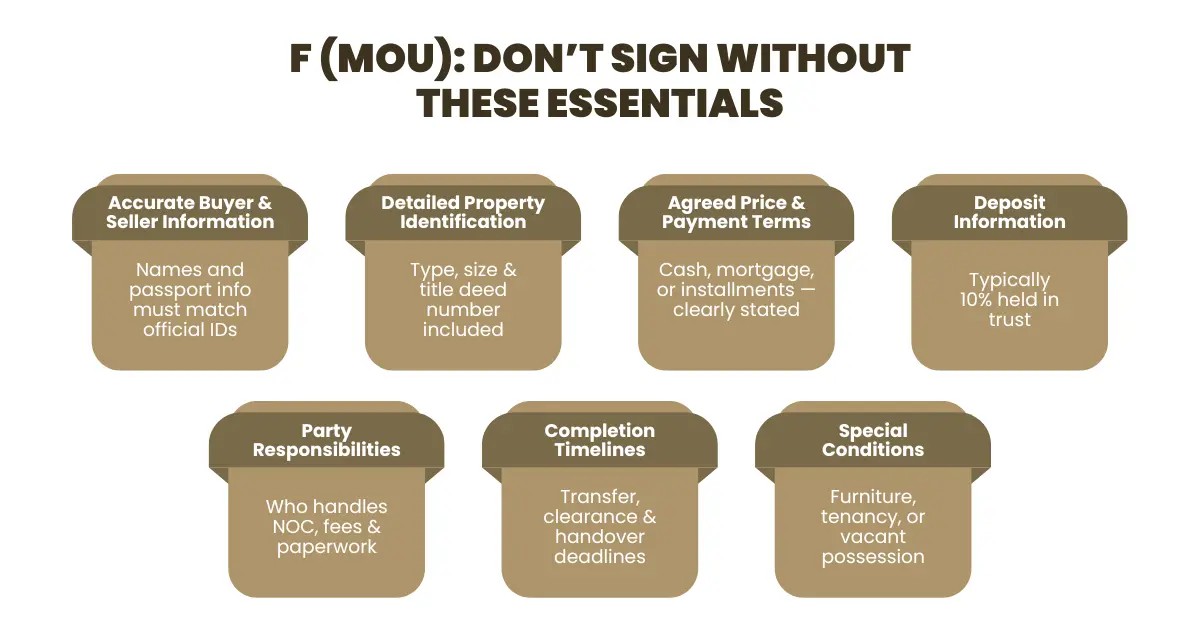
- Accurate Buyer & Seller Information: Full legal names and passport details must match official IDs to provide proof of the parties involved.
- Detailed Property Identification: Include property type, size, and title deed number for further identification.
- Agreed Sale Price & Payment Terms: State the total price and payment method, whether cash, mortgage, or installments.
- Deposit Information: Specify the amount held in trust, typically 10% of the sale price.
- Party Responsibilities: Outline who handles NOC issuance, service charges, and documentation.
- Completion Timelines: Set deadlines for final transfer, NOC clearance, and property handover.
- Special Conditions: Include furniture, appliances, vacant possession, or existing tenancy terms.
Compliance Update (2025)!
Recent updates make Form F more secure online. Buyer and seller identities are verified digitally through Emirates ID or UAE Pass, MOUs include a QR code linking to DLD records, and all agreements use English and Arabic for clarity.
Who Prepares Form F and How Much Is the MOU Deposit?
Form F (MOU) is usually prepared by the real estate broker managing the sale. They will fill in details like the agreed price, payment terms, and property information, based on input from the buyer and seller. Both parties must approve the information before signing. The Dubai Land Department (DLD) and RERA review and authorize the form, while legal advisors can verify fairness. The standard MOU deposit is 10% of the purchase price, typically paid by the buyer via cheque, held securely by the agent. If the buyer withdraws without a valid reason, the deposit may be forfeited; if the seller defaults, the deposit is refunded.
Steps to Sign the MOU in Dubai
Signing Form F is straightforward:
- Buyer and seller agree on the sale terms.
- The seller’s agent drafts the MOU using the DLD’s electronic Form F.
- Both parties review electronic copies.
- After approval, both sign digitally, making it legally binding.
Processing Time? In a property sale transaction, most time is spent for negotiating the terms of the deal. Once the contract terms are negotiated and agreed, creating the contract through the portal may take 1-2 days depending on the terms. Once created, the seller and buyer can sign it electronically through the DLD link which can take another 1-2 days. Signing the Contract Form F manually is not anymore an option, because since 2024, the DLD has mandated the use of its digital system for generating and signing Form F.
What Happens After Signing Form F?
Once signed, the property sale progresses quickly:
- Buyer applies for a mortgage if needed.
- Seller obtains the NOC from the developer.
- Both parties meet at the Property Trustee’s office to complete the transfer and settle the remaining amount.
- The DLD issues the new title deed.
Tip! Form F transactions involve the DLD registration fee (4% of the property price)along with the trustee office fee and the title deed fee (~AED 580). Learn more about typical fees involved with buying property in the UAE.
Avoid These Mistakes When Completing Form F (MOU) (Practical Guide)
Completing Form F (MOU) is one of the most sensitive points in any Dubai property sale. Small errors can trigger disputes, delay registration with DLD, or put deposits at risk. We’ve seen legal friction in property transactions because of Form F’s unclear terms, missing conditions, financing gaps, tenant issues, or basic inaccuracies. Avoid costly setbacks by identifying common pitfalls:
- Wrong or Missing Details: Incorrect names, prices, property info, or unsigned sections.
- Unclear Terms: Payment dates, handover timelines, penalties, or included fixtures are not stated.
- Financing Gaps: No mortgage approval, no valuation conditions, or no protection if funding fails.
- Tenant and Occupancy Issues: No notice, missing Ejari, or rent transfers not documented.
- Deposit Risks: Handing the 10% cheque before the terms and conditions are final.
- Unlicensed Advice: Brokers with no RERA licence leading to invalid agreements.
Take the Next Step With Expert Form F Guidance
Completing a Form F (MOU) is mandatory for any Dubai property transaction and forms a legally binding sales contract once signed by certified brokers. Understanding the importance of Form F (MOU) helps avoid errors, delays, or disputes. For reliable support in completing your Contract Form F (MOU), trust Lex Estates. Our experts guide you through every step, verify details, and manage registration with the Dubai Land Department. Contact us to secure your Dubai property purchase today.
Faqs
How do I create Form F on the Dubai REST app?
Log in as a business user, go to Dubai Brokers, select Contracts, find an active contract, and click Create to generate Form F.
Can I cancel Form F in Dubai?
Yes, both buyer and seller must agree. Cancellation is done via the Dubai Land Department or the broker handling the deal. There are penalties involved.
Can Form F be modified after signing?
Changes need both parties’ agreement. The updated form must be re-signed and submitted to the Dubai Land Department
What does Form F contain?
Form F lists property details, financials, mortgage info, buyer and seller data, responsibilities, deposit terms, and contract reference for legal clarity.
What is the difference between an MOU for off-plan and ready properties?
Off-plan uses SPA under developer escrow law; ready properties use Form F via DLD, with different deposits, transfer timing, and legal oversight.