Evicting a Tenant in Dubai needs strict compliance of Dubai Tenancy Laws. Landlords need to strictly fulfill legal protocols, complete documentation, and have an understanding of the regulations that govern landlord-tenant relationships.
The eviction procedure is governed by clear requirements under Dubai Law No. 26 of 2007 and Law No. 33 of 2008. A 30-day notice for non-payment and 12 months notice for other legal reasons, like sale or personal use, is mandatory via notary services and registered email. In case of any rRefusal or disputes, the landlord can file a lawsuit with the Rental Disputes Settlement Center.
At Lex Estates, we approach the procedure of evicting a tenant in Dubai with the precision and discretion your investment portfolio deserves. Our experts have explained every critical step, from establishing legal grounds to navigating the Rental Dispute Settlement Centre.
How Dubai’s Tenant Eviction Framework Works
Dubai’s tenancy operates under three key authorities: the Dubai Land Department (DLD), the Real Estate Regulatory Agency (RERA), and the Rental Dispute Settlement Centre (RDSC). Unlike jurisdictions where landlords hold discretionary power, Dubai tenancy law structures eviction as a formal legal process with defined grounds, notice periods, and an enforcement process.
Article 25 of Law No. 33 of 2008 explains eviction rights, distinguishing between mid-lease evictions (for tenant breaches) and end-of-lease evictions (for landlord needs). Before any eviction can proceed, your property must be registered with Ejari, which is Dubai’s tenancy registration system. Without Ejari documentation, you cannot file a case at the RDSC, regardless of how legitimate your grounds may be.
Legal Procedure Of Evicting a Tenant in Dubai
Before we proceed further, let’s understand what the legal grounds are for evicting a tenant in Dubai.
Eviction During The Lease Term -Article 25(1)
The law permits mid-lease termination only when tenants violate specific contractual or legal obligations.
- Valid grounds include non-payment of rent after 30 days’ written notice or illegal subletting without consent.
- The other reasons include using the property for prohibited purposes, causing significant damage through negligence, or leaving commercial premises unoccupied for extended periods.
- A 2024 amendment added unauthorized short-term rental listings as grounds for immediate eviction, reflecting Dubai’s evolving regulatory stance on platforms like Airbnb.
- For any breach-based eviction, you must first issue a notice giving the tenant 30 days to correct the violation.
- Only if they fail to comply can you proceed with formal eviction proceedings with immediate effect.
Eviction Upon Lease Expiry-Article 25(2)
End-of-lease evictions require 12 months’ written notice before the contract’s expiration date. Acceptable grounds include:
- Personal use by the owner or a first-degree relative (provided you can demonstrate no suitable alternative property).
- Property sale
- Comprehensive renovation
- Demolition requiring a Dubai Municipality permit
- Government-mandated development requirements.
The 12-month notice period is non-negotiable. Serving notice for less than 12 months invalidates the entire process, forcing you to wait another full lease cycle.
| Scenario | Notice Period | Key Requirement |
| Non-payment of rent | 30 days | Written payment notice first |
| Lease violation | 30 days | Written breach notification |
| Personal use | 12 months before expiry | Proof of no alternative property |
| Property sale | 12 months before expiry | Via notary public or registered mail |
| Renovation/demolition | 12 months before expiry | Dubai Municipality permit/report |
Step-by-Step Procedure For Evicting a Tenant in Dubai
Here is the step-by-step guide that landlords can follow for a legal tenant eviction.
Step 1: Establish and Document Your Legal Grounds
The foundation of any successful eviction depends on documentation. Collect your tenancy contract, Ejari certificate, rent payment records, and any evidence supporting your eviction reason. Photographs of property damage, email correspondence about lease violations, or technical reports for renovation-based evictions are the main documents. Our property conveyancing services in Dubai include a comprehensive document review to ensure your case meets all legal thresholds before you proceed.
Step 2: Draft a Legally Compliant Eviction Notice
Your eviction notice must include the landlord’s and tenant’s full details, the property address, the specific legal ground for eviction, the applicable notice period, and your signature. The notice must be drafted in Arabic, though including an English translation is highly recommended for complete clarity. Generic templates often lack the legal precision required for RDSC proceedings. You can engage the services of POA.ae to ensure your notice withstands judicial scrutiny.
Step 3: Notarize the Eviction Notice
Take notice of a Dubai Courts Notary Public along with your lease agreement, Ejari registration, title deed, and Emirates ID. The notarization creates an official court record and confirms the document’s authenticity. This step is mandatory; unnotarized notices have no legal standing.
Step 4: Serve the Notice Through Official Channels
Dubai law recognizes three delivery methods, and you can use any of them. These methods are in-person service through a Dubai Courts Notary Public, registered mail via Aramex with tracking confirmation, or the RDSC Electronic Notification system. WhatsApp messages, standard emails, and verbal conversations don’t have any legal standing. Keep all proof of delivery with you as a record. This documentation becomes critical if the tenant contests the eviction.
Step 5: Register in the RERA Digital Eviction Database
A 2025 DLD update now requires all eviction notices to be registered in the RERA Digital Eviction Database before filing with the RDSC. This database creates a centralized record and prevents landlords from circumventing proper notice procedures. This registration step is frequently overlooked but essential.
Step 6: File at the Rental Dispute Settlement Centre
If your tenant fails to vacate after the notice period expires, file a case through the Rental Dispute Settlement Centre. The RDSC first routes cases to mediation, aiming for resolution within 15 days. If mediation fails, the case proceeds to a First Instance Circuit hearing, typically concluding within 30 days. Should either party appeal, the case moves to the Appeal Department, which requires a 50% deposit of the disputed amount for claims exceeding AED 100,000 and must be filed within 15 days of the initial ruling.
RDSC filing fees are calculated at 3.5% of the annual rent, with a minimum of AED 500 and a maximum cap of AED 20,000 for standalone eviction cases. Additional costs include process service fees (approximately AED 100), knowledge and innovation fees (AED 10 each), and Power of Attorney registration if applicable.
Critical Rules Landlords Must Observe After Eviction
Evicting a tenant for personal use triggers a two-year prohibition on re-renting residential properties or three years for commercial units. Violating this restriction exposes you to compensation claims typically equivalent to one year’s rent.
If you evict a tenant for renovation purposes, that tenant holds the first right of refusal to return once construction is complete; you must notify them within 30 days of the work’s completion.
A significant 2024 ruling clarified that eviction notices now “travel with the property.” If you sell a property in Dubai after serving a 12-month notice, the new owner inherits that notice; they do not need to restart the clock. This protects buyers in the secondary market from tenants claiming notice invalidity upon ownership transfer.
Common Mistakes That Invalidate an Eviction Notice in Dubai
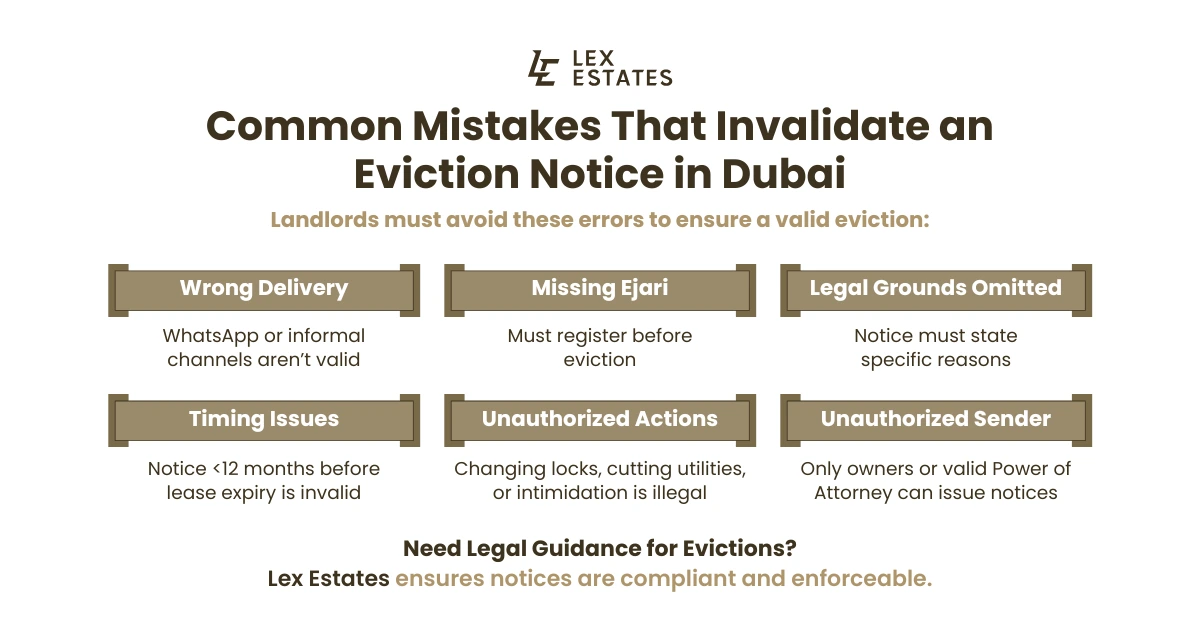
If you are a landlord and make a mistake while giving an eviction notice to tenants, your case may be ruined. The small but impactful mistakes that can legally void a notice include:
- Serving notice via WhatsApp rather than official channels
- Failing to register Ejari before initiating eviction
- Omitting the specific legal ground in the notice text
- Issuing a notice fewer than 12 months before the lease expiry
Attempting to force a tenant out by changing locks, cutting utilities, or physical intimidation constitutes unlawful eviction and may result in criminal penalties.
Another common error involves sending notices from unauthorized parties. Only the registered property owner, or someone holding a valid Power of Attorney, can issue an eviction notice.
Procedure of Evicting a Tenant in Dubai Through Lex Estates
Protecting a high-value property investment requires more than understanding the law; it demands a clean and well-informed execution. At Lex Estates, our legal-first approach to property services in Dubai helps in simplifying the procedure of managing your properties, including arranging eviction notices for a tenant in Dubai. Through our network of licensed service providers, we can arrange serving legally compliant eviction notices to your tenants.
Whether you’re looking to buy, sell, or manage properties in Dubai, at Lex Estates, we provide the discretion and diligence your investment deserves. Learn more about Lex Estates and our comprehensive approach to real estate services.
Свяжитесь с Lex Estates today to speak with our team about your property needs.
FAQS:
How long does it take to evict a tenant in Dubai?
It usually takes 12 months to evict a tenant in Dubai for legal reasons. In case of non-payment, you can evict them in 30 days as per laws.
What is the fastest way to get a tenant out?
You can file a lawsuit with RDSC against the tenants on legal grounds. Then the court issues a sheriff or marshal and removes the tenants as per order.
What are the most common reasons for eviction?
The main reasons for the eviction of tenants are usually non-payment or illegal use. Others include the personal use, property sale, or repurposing of the property.