If you own property in Dubai as a non-Muslim investor, one legal question has the power to dictate every financial decision you’ve ever made: what happens to your UAE assets when you die?
Without a registered will, UAE courts apply Sharia inheritance law by default, regardless of your nationality, your family’s wishes, or the value of your portfolio. The DIFC Wills Service Centre exists to change that. Our experts at Lex Estates explain everything in this guide that international investors need to know, including the most recent update under Dubai Law No. 2 of 2025.
What Is the DIFC Wills Service Centre?
The DIFC Wills Service was established by Resolution No. 4 of 2014 and its authority reaffirmed by Dubai Law No. 15 of 2017, which regulates inheritance, wills, and probate for non-Muslims. The Wills Service and Registry are governed by rules developed by reference to international best practice and based on Common Law principles.
In plain terms, it is a dedicated government registry that allows non-Muslim individuals to register an English-language will in Dubai, granting them full control over how their UAE assets are distributed after death.
A DIFC Will ensures that UAE Sharia law will not be applied to the estate of a non-Muslim, and once a probate order is issued by the DIFC Court, it is capable of being enforced across the UAE without the need for further legal action through the UAE local Courts.
The 2025 Update About DIFC Wills and Probate Registry
Under Dubai Law No. 2 of 2025, DIFC Wills have exclusive jurisdiction and direct enforcement for assets located in Dubai. This means a DIFC-registered will can be enforced directly through the DIFC Courts without needing to go through the Dubai Courts, a significant procedural advantage for Dubai-based assets.
For investors holding Dubai Land Department (DLD)-registered properties, this means faster probate, fewer procedural hurdles, and lower legal costs for your beneficiaries.
Who Can Register a DIFC Will?
Eligibility is straightforward for the compliant applicants to register a DIFC Will in Dubai/UAE:
- You must be non-Muslim
- You must be 21 years of age or older
- You must have assets, family, or both in the UAE; residency is not required
Any non-Muslim having either assets or family in the UAE can register a DIFC Will. This makes the registry equally accessible to full-time Dubai residents, part-time residents, and international investors who own UAE property but are based abroad.
The 5 Types of DIFC Wills: Which One Do You Need?
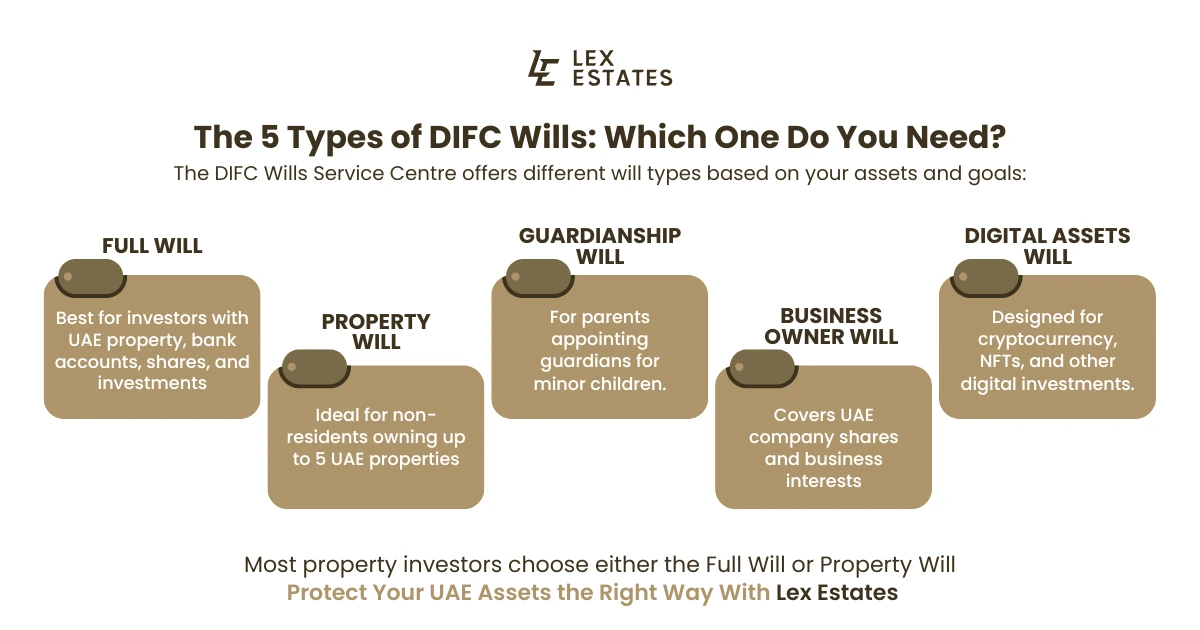
The DIFC Wills Service Centre offers several will types. The Full Will is the most comprehensive type, designed to cover all types of assets you may hold within the UAE, including UAE property, bank accounts, business shares, and investments.
The Property Will is specifically tailored to address real estate holdings in the UAE, covering one or multiple properties (up to five) across Dubai, Abu Dhabi, or other Emirates, ensuring legal transfer of ownership and overriding forced heirship rules for those specific assets.
Here is a quick overview of all five types:
| Will Types | Best For |
| Full Will | Investors with diverse UAE assets, property, investments, and business interests |
| Property Will | Non-residents who own up to 5 UAE properties with no other UAE assets |
| Guardianship Will | Parents of minor children in Dubai or RAK |
| Business Owner Will | Those with UAE company shares or commercial interests |
| Digital Assets Will | Investors holding cryptocurrency or NFTs, the DIFC Courts offer specific provisions, including a non-custodial wallet for certain digital assets like Ethereum (ETH), Bitcoin (BTC), and NFTs |
Important Note: For most international property investors, the Full Will or Property Will is the most relevant option.
Learn about Inheritance & Wills in Dubai Real Estate: Protecting Your Assets, in our recent blog.
What Happens Without a DIFC Will? The Real Risk for Investors
In the absence of a Will, the UAE courts apply Sharia Law to the distribution of assets of all non-Muslims, either living or having assets in the UAE. This means that your spouse, children, and all other legal heirs will share your assets in accordance with the distribution mechanism devised by Sharia Law. Your legal heirs may include your parents, brothers, and sisters. The probate process may also be time-consuming in the absence of a Will.
For property investors specifically, this creates three compounding problems:
- Your DLD-registered property cannot be transferred until the courts resolve the estate, a process that can take months or years.
- Your chosen beneficiaries may receive less than you intended, or nothing at all, if Sharia inheritance shares differ from your wishes.
- Bank accounts can be frozen immediately upon death notification, cutting off funds your family may need urgently.
A DIFC Will eliminates all three risks.
How to Register a DIFC Will: Step-by-Step
The timeline from draft to registration is commonly 3 to 60 working days once information is complete and an appointment is given by DIFC. The process breaks down into four stages:
Step 1: Choose your will type and appoint a draftsman:
Work with a legal practitioner registered with the DIFC Wills Service Centre. The DIFC publishes an official list of approved draftsmen. You cannot use an unregistered lawyer.
Step 2: Draft and review:
Your draftsman prepares the will to DIFC drafting standards. You review, approve, and sign off on the document.
Step 3:Book your appointment and upload the will
The will is uploaded to the DIFC portal, and an appointment is scheduled, either in person at the DIFC Courts building or via the Virtual Registry.
Step 4: Sign with two witnesses:
The registration process requires two witnesses to sign the will simultaneously. These witnesses can join the same video conference from different locations and insert electronic signatures through their mobile devices on a link provided directly by the DIFC. The witnesses should not be beneficiaries or guardians mentioned in the will, or spouses of beneficiaries or guardians.
Once signed, your registered will is electronically stored, and a certified copy is issued to you.
DIFC vs ADJD Wills: Which Should International Investors Choose?
The main differences are cost and enforcement. A DIFC will cost AED 10,000 to register and has direct enforcement in Dubai. An ADJD will cost AED 950 to register and is valid across all seven UAE emirates under federal law.
For international investors with Dubai property only, the DIFC route is the stronger choice, particularly following the 2025 law update. For investors with assets spread across multiple emirates, ADJD may offer a broader reach at significantly lower registration costs. Consult a specialist to confirm the right route for your specific portfolio.
Costs and Fees at a Glance
A DIFC Full Will costs AED 10,000 in registration fees (AED 15,000 for mirror wills), plus AED 3,000 to 10,000 in legal drafting fees. Total cost is typically AED 13,000 to 21,000 or more. All fees are subject to 5% VAT.
The registration fee for an amendment to an existing DIFC Will is AED 550 plus VAT.
For probate after the testator’s death, the executor files an application for a Grant of Probate at the Registry. Upon receipt of the application and paperwork, the Registry assigns a Case Progression Officer who serves as the executor’s point of contact throughout the probate proceedings.
The Bottom Line for Dubai Property Investors
Registering a DIFC Will is not a legal formality; it is one of the most impactful financial decisions you can make as an international investor in Dubai. It protects your property, your portfolio, and your family from a legal default that applies the moment you pass away without one.
The cost is a fraction of the value of a single Dubai property. The risk of not acting is potentially losing control of your entire estate.
At Lex Estates, we specialise in helping international investors buy and sell property in Dubai. And because we know that protecting your investment goes beyond the transaction, we connect our clients with trusted legal professionals who can guide them through the DIFC Wills and Probate Registry process. Ready to invest in Dubai with confidence? Speak to our team today.
Часто задаваемые вопросы
Do I need to be in Dubai to register?
No. The DIFC Courts now offer a Virtual Registry that allows you to register your will remotely via video conference.
Can a married couple share one will?
No. DIFC uses individual wills. Couples often register two single wills, also known as mirror wills, usually signed at the same appointment.
Can I update my will after registration?
Yes. You can update or revoke your DIFC Will at any time. To update, you can create an amendment or a new will. To revoke, you withdraw your will and notify the DIFC Wills Registry.
Does a DIFC Will cover assets outside the UAE?
DIFC Wills now automatically cover all movable and immovable assets throughout the UAE. DIFC Wills may also cover movable and immovable assets situated in other countries around the world, subject to legal advice.
What if I am Muslim?
The DIFC Wills Registry is open exclusively to non-Muslims. Muslim investors should seek separate legal guidance on UAE estate planning.
Can I appoint my own executor?
Yes. You can appoint one or more executors, including family members, a legal professional, or a combination of both.