
Inheritance & Wills in Dubai laws are governed by three overlapping legal frameworks: Sharia law, the UAE Personal Status Law, and, for qualifying non-Muslims, Federal Decree-Law No. 41 of 2022. When any of these apply to your estate, the Dubai Land Department cannot transfer your property until the Personal Status Court issues a succession order. That process can take months.
It can strip a surviving spouse of a share they expected. It can distribute a jointly owned asset to heirs nobody planned for. This guide answers the most critical inheritance questions for Dubai real estate owners, UAE nationals, Muslim expatriates, and non-Muslim foreign investors alike.
What Would Actually Happen to Your Dubai Property If Something Unfortunate Happened to You?
If you own property in Dubai, your estate does not automatically pass to your spouse or chosen family. Instead, your assets may be frozen, court procedures begin, and inheritance laws determine who receives what.
Without a registered UAE will, jointly owned property can be divided unexpectedly, bank accounts may be blocked, and legal delays can last months or even longer. Recent legal changes have also introduced new risks, especially for expatriates, single investors, and cross-border asset holders.
Understanding these scenarios is essential before making decisions. The sections below explain exactly what happens and how you can protect your property.
What Happens To a Dubai Property When the Owner Dies?
When a property owner dies in Dubai, the asset is frozen immediately. It cannot be sold, transferred, or mortgaged until the court resolves the inheritance matter. The process begins with an application for a Heirship Certificate (also known as Succession Certificate) at the Personal Status Court and ends with the Dubai Land Department transferring the title deed to the confirmed heirs.
With a registered will, this process is structured and relatively fast. Without one, it can involve multiple court hearings, Arabic translations of foreign documents, and timelines that stretch well beyond a year. The outcome, who receives the property, depends entirely on whether a valid UAE will exist and what inheritance law applies to the deceased.
Can Foreigners Register a Will in Dubai?
Yes, every non-Muslim expat who owns property in Dubai should have a UAE will. A will from your home country does not automatically apply to assets in the UAE.
There are three main options:
- ADJD wills (from AED 950): most affordable, valid across all Emirates
- Dubai Courts wills (from AED 2,167): suitable for Dubai-based assets
- DIFC wills (from AED 10,000): fastest and most direct enforcement for Dubai property
The DIFC Wills Service Centre is often considered the best option for Dubai real estate, especially after Dubai Law No. 2 of 2025. Choosing the wrong option, or not having a will at all, can cause serious issues after death.
What Is the DIFC Wills and Probate Registry?
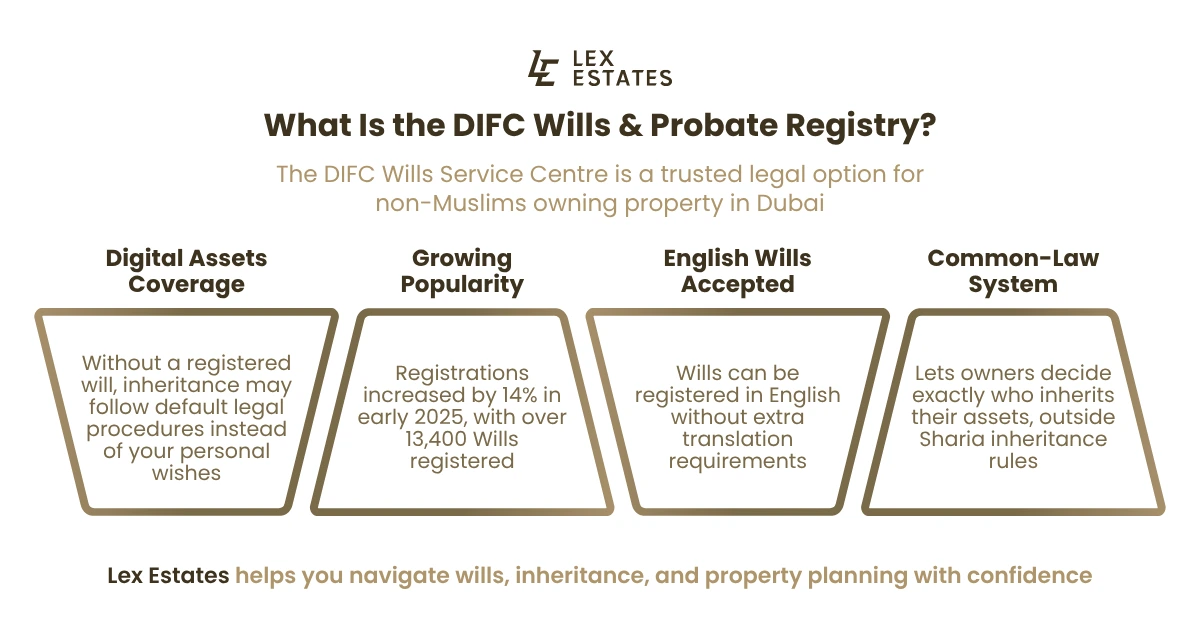
The DIFC Wills Services Centre (formally the DIFC Wills and Probate Registry) is one of the strongest legal options for non-Muslims who own property in Dubai. It follows a common-law system, not Sharia Law, allowing owners to clearly choose who inherits their assets. Wills can also be written in English, without translation or extra legal approvals.
Registrations with the DIFC Wills Service Centre increased by 14% in early 2025 compared to 2024, showing growing trust among expatriates. Since launching, more than 13,400 Wills have been registered.
For people with modern investments, the DIFC now offers a Digital Assets Will, covering assets like Cryptocurrency and other online holdings. This is becoming increasingly important as more expatriates in the United Arab Emirates invest in digital wealth.
What Happens to Jointly Owned Property When One Owner Dies?
Joint ownership does not automatically protect the surviving owner in the United Arab Emirates. When one owner dies, banks freeze all accounts, including joint accounts, because the UAE does not recognise the right of survivorship.
The deceased person’s share becomes part of their estate. The surviving owner keeps only their registered portion, while the remaining share is distributed to legal heirs. Without a will, this may include children, parents, or other relatives, meaning the surviving owner could end up sharing the property with people they never chose.
The outcome also depends on the deceased person’s religion. In many cases, inheritance may follow Sharia Law or other applicable laws in the UAE, which can significantly change how the property is divided.
Is Sharia Law Automatically Applied to Your Property?
For Muslims, yes, Sharia Law applies automatically to inheritance in the United Arab Emirates.
For non-Muslims, the rules changed in February 2023 under Federal Decree‑Law No. 41 of 2022. If a non-Muslim expatriate dies without a will, their estate is typically divided as follows:
- 50% to the spouse
- 50% shared equally among children, regardless of gender
This made a major shift away from traditional Sharia inheritance rules.
However, this change does not remove all risks. Legal complications can still arise if:
- Property is jointly owned with a Muslim individual
- Assets fall under the UAE Civil Code
- Assets are spread across multiple countries or jurisdictions
In simple words, the law changed the default inheritance rules, but it did not replace proper estate planning. Creating a will is still the safest way to ensure your assets are distributed according to your wishes.
What Happens If You Die Without a Will in the UAE and Have No Heirs?
In the United Arab Emirates, this situation has serious consequences, and the rules changed in January 2026 under Federal Decree-Law No. 51 of 2024.
If an expatriate dies without a registered will and no legal heirs can be identified, their UAE assets are first frozen. After official checks confirm there are no heirs, those assets may be transferred to a government-managed charitable fund known as Waqf.
This makes having a will especially crucial for:
- Single residents
- People whose families live outside the UAE
- Property investors without immediate dependents
In simple terms, if you don’t have a will and no heirs are found, the state may inherit your assets by default.
What Is Probate and How Does It Work in the UAE?
Probate is the legal process used to confirm a deceased person’s assets, settle any debts, and distribute what remains to the rightful heirs. In the United Arab Emirates, probate is usually handled through the Personal Status Courts. If a person has a DIFC will, the process is managed by the DIFC Courts under its own legal framework.
The process typically starts with obtaining a Heirship Certificate, which confirms the legal beneficiaries. Once approved and a decision is taken by the competent courts, assets such as property are transferred to heirs through authorities like the Dubai Land Department.
One key advantage is that the UAE does not charge inheritance tax, making asset transfers simpler than in many countries. However, this benefit can quickly disappear if probate is delayed, disputed, or complicated, especially when no will is in place.
Plan Before the Court Does: Talk to Lex Estates Today
Dubai property ownership comes with a legal framework that is precise, enforceable, and entirely indifferent to what you assumed would happen. Whether you are a UAE national, a Muslim expatriate, or a non-Muslim foreign investor, the law has a default position for your estate.
Structuring your real estate ownership in the right way, whether through foundations, trusts, or property holding entities, including registering a Will, is the only way that confirms how your estate is distributed and you can control your assets. At Lex Estates, we deal in the buying and selling of property for international and local investors. Contact us today to start investing in the Dubai real estate market with the right structure.
Часто задаваемые вопросы
Does a surviving spouse automatically inherit a jointly owned Dubai property?
No. The surviving spouse retains only their own registered share. The deceased’s portion enters the estate and is distributed per law or a registered will, meaning children, parents, and other legal heirs may receive a share of the property before the spouse receives anything additional.
Is there inheritance tax on Dubai property?
No, the UAE imposes no inheritance tax. However, there are court fees, translation costs, attestation fees, and potential legal representation costs involved in the probate process, all of which increase significantly when no will is in place.
What is the most affordable way to register a will in Dubai or in UAE generally?
An ADJD Will start from AED 950 in government registration fees, is valid across all seven Emirates, and can be completed entirely online. For those with significant Dubai-based real estate, it is advisable to go with Dubai Courts Will registration for a fee of AED 2,100. Alternatively, a DIFC will offer faster enforcement in English only, but at a considerably higher cost, from AED 10,000. There are additional fees paid to lawyers or draftsmen for legal drafting in all cases.
Can I include digital assets or overseas property in my UAE will?
Yes. A DIFC-registered will can include digital assets such as cryptocurrency. For overseas property, it is advisable to draft a separate will in the relevant jurisdiction, while ensuring that both documents do not conflict with each other.