
If a property owner dies in Dubai, the property does not simply pass to the family overnight. There is a legal process, and without the right preparation, that process can be slow, expensive, and deeply stressful for the people left behind.
There are two scenarios to consider: one where the owner has registered a will, and one where no will exists. On top of that, the rules differ for Muslims and non-Muslims, with or without a will. So let’s discuss everything you need to know if the owner dies in Dubai.
| Key Takeaways When a property owner dies in Dubai, the property does not automatically transfer to the family; a court process must happen first. Muslims follow Sharia law, while non-Muslims are now covered under Federal Decree-Law No. 41 of 2022. Without a registered will, property can be frozen for months, rental income blocked, and distribution may not match your wishes. There are no inheritance taxes in Dubai, but DLD transfer fees apply. Registering under DIFC or Dubai Courts or ADJD is the smartest step any non-Muslim property owner can take today. |
Does Property Automatically Transfer to the Family if the Property Owner Dies?
This is the first question most families ask, and the honest answer is: legally yes, practically no.
Under UAE law, heirs acquire rights to the deceased’s estate at the moment of death. However, the Dubai Land Department (DLD) will not update the title deed or allow any sale, mortgage, or transfer until the courts officially confirm who the heirs are and what each person is entitled to receive. Until that confirmation arrives, the property stays frozen in the deceased’s name, untouchable.
Which Law Applies to Your Property?
This depends on who you are, and it matters the most. For Muslims, Sharia law governs inheritance under the UAE Personal Status Law No. 28 of 2005. For non-Muslims, a landmark change came with Federal Decree-Law No. 41 of 2022 on Civil Personal Status, which took effect in February 2023. Under this law, if a non-Muslim expat dies without a will, the default distribution is now 50% to the surviving spouse and the remaining 50% divided equally among children, regardless of gender, rather than applying Sharia rules automatically as was previously the case.
Still, even this default may not match your exact wishes. A will remains the most reliable way to stay in control.
| Situation | Law Applied | Risk Level |
| Muslim, no will | Sharia forced heirship | Medium |
| Non-Muslim, no will | Federal Decree-Law No. 41 of 2022 default | Medium |
| Non-Muslim, registered Will in UAE | Will terms/home country law | Low |
| Any owner, registered Will | Will terms | Low |
What Happens Step by Step After a Property Owner Dies?
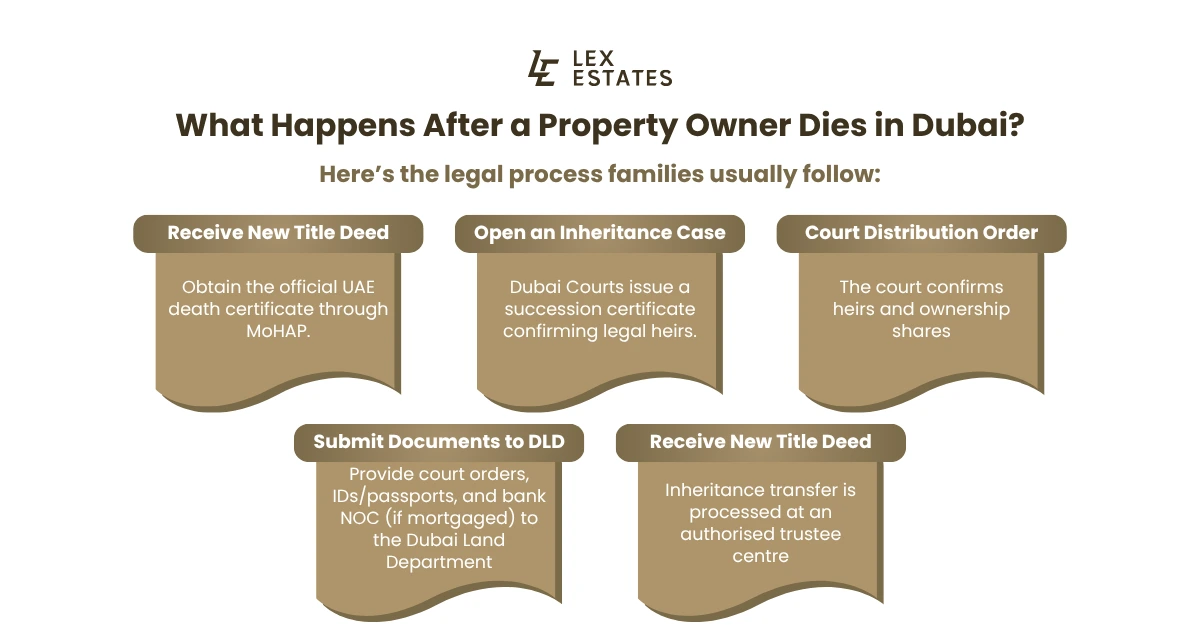
Here is the practical sequence your family will need to follow:
1. Register the Death
Obtain an official UAE death certificate through the Ministry of Health and Prevention (MoHAP). This is the starting point for every step that follows.
2. Open an Inheritance Case at Dubai Courts
Heirs must obtain a Legal Notification of Inheritance, also called a succession certificate, from Dubai Courts, other UAE courts, or the Awqaf and Minors Affairs Foundation. This document confirms the identity and entitlement of each heir and serves as the legal basis for registering the property in their names. If there is a valid Will, the courts determine the beneficiaries based on the Will.
3. Court Issues a Decree of Distribution
The court identifies all heirs and their legal shares. If minors are involved, the Awqaf and Minors Affairs Foundation must also authorise the registration.
4. Submit Documents to DLD
The Dubai Land Department requires a Decree of Distribution or equivalent probate order, plus an official court letter instructing the property transfer. Heirs must also provide Emirates ID copies for resident heirs, passport copies for non-resident heirs, and a No Objection Certificate from the bank if the property is mortgaged.
5. Receive the New Title Deed
For most heirs with documentation ready, DLD processes the inheritance title transfer in approximately 25 minutes at an authorised Real Estate Services Trustee Centre.
What If There Is a Mortgage on the Property?
The mortgage does not disappear if the owner dies. The bank becomes a creditor in the estate, and heirs cannot sell or transfer the property until the outstanding debt is resolved. If there is liability in place, the court may freeze the property entirely until all financial obligations are cleared. This can add months to an already lengthy process.
What About Rental Income If the Property Owner Dies?
If the deceased owned a rental property, the income does not automatically continue flowing to the family. Rental income becomes part of the frozen estate, and family members cannot legally access it, renew tenancy contracts, or make decisions about the property until the court appoints an administrator. For landlords with multiple properties, this can mean significant financial disruption during a time that is already difficult enough.
Are There Inheritance Taxes in Dubai?
No, there is no inheritance tax in the UAE. The UAE does not impose any inheritance or estate tax on the transfer of assets from a deceased individual to their heirs.
However, there are fees to be aware of. DLD charges AED 1,000 per property collected from the heirs and AED 250 for issuing the new title deed, plus map fees and service-partner charges at trustee centres. These are manageable costs compared to the legal fees that can pile up when there is no will, and the courts need to work everything out from scratch. The DLD would charge additional transfer fees if legal heirs re-assign property shares among themselves during the probate process. If one heir gives or sells their share to another, the DLD treats this as a separate transaction. A transfer fee of 0.125% of the property value (min. AED 2,000) applies for gifts between first-degree relatives. If not structured as a gift between qualifying relatives, the standard 4% transfer fee could be triggered.
Will vs. No Will: Why It Changes Everything
Without a will, your family faces property freezes, potential court delays, blocked rental income, and distribution outcomes that may not reflect what you actually wanted. With a registered will, especially a DIFC will for non-Muslims, the process is faster, cleaner, and entirely predictable.
Non-Muslims who register a DIFC will benefit from a direct probate order issued by DIFC Courts, which, under a Memorandum of Understanding with DLD, is enforceable through Dubai Courts and then presented to DLD for ownership transfer. Estates with a properly registered DIFC will typically move to the DLD title transfer stage faster than intestate estates requiring full Dubai Courts probate.
What Should You Do Right Now?
If you own property in Dubai and do not have a registered will, this is your action plan:
Step 1:
Check whether you have a will registered in Dubai, at DIFC, Dubai Courts, or ADJD.
Step 2:
If not, register one. Non-Muslims should strongly consider the DIFC Wills Service for English-language, common law-based protection.
Step 3:
Make sure your family knows where your property documents and DLD registration details are stored.
Step 4:
Speak to a real estate lawyer who understands the inheritance implications specific to your situation.
Protect Your Property: Contact Lex Estates
If a property owner dies, navigating property inheritance in Dubai is not easy and simple, especially if you have not registered a will. At Lex Estates, our agents work with trusted legal partners to ensure your property reaches the right hands quickly, legally, and without unnecessary complications.
Whether you are buying or selling a property, planning ahead, or already dealing with an inherited property, contact Lex Estates today and let us guide you through every step.
Read about Inheritance & Wills in Dubai Real Estate: Protecting Your Assets in our recent blog.
Вопросы и ответы
What happens to property in Dubai when the owner dies without a will?
The property is frozen in the deceased’s name until the Dubai Courts confirm the heirs and issue a Decree of Distribution. For non-Muslims, Federal Decree-Law No. 41 of 2022 provides a default distribution of 50% to the spouse and 50% equally among children, but the court process still applies.
Can a foreigner inherit property in Dubai?
Yes. Foreign heirs can inherit Dubai property. They will need to go through the Dubai Courts to obtain a succession certificate and then complete a title transfer at DLD.
Does Sharia law apply to non-Muslims who own property in Dubai?
Not automatically anymore. Under Federal Decree-Law No. 41 of 2022, non-Muslims now have a separate civil default. However, registering a DIFC will give non-Muslims the greatest control over how their assets are distributed.
Is there inheritance tax on property in Dubai?
No. There is no inheritance or estate tax in the UAE. Standard DLD transfer fees apply when the title deed is moved to the heirs’ names.
How long does property inheritance take in Dubai?
The DLD title transfer itself takes around 25 minutes once all documents are ready. The Dubai Courts process, obtaining the succession certificate, is the main variable and can take weeks to several months, depending on complexity.
Can a wife automatically inherit her husband’s property in Dubai?
Not automatically. The property must go through the court inheritance process first. For non-Muslims without a will, the default gives 50% to the surviving spouse under the 2022 law. For Muslims, Sharia rules determine the spouse’s share.