
Subletting can help tenants offset their rental costs, particularly when they spend extended periods away from the property. It is for this reason that many tenants in Dubai choose to rent out their property to friends, family, or strangers, often without informing the landlord.
However, strict legal restrictions on subletting in Dubai are enforced by both the Dubai Land Department (DLD) and Dubai Municipality. Subletting without proper authorisation can result in lease termination, eviction of the subtenant, and fines of up to AED 50,000. This guide explains how to sublet legally, what the law requires, and what happens if you get it wrong.
What Is Subletting in Dubai?
Subletting or subleasing occurs when a tenant who has rented a property from a landlord allows another person to occupy the property, either in full or in part, in exchange for payment. This is commonly done by tenants who travel frequently, spend extended time out of the country, or wish to share rental costs.
Under Dubai rental law, subletting is permitted only when written permission has been obtained from the landlord, and all other legal requirements are met. Subletting without this consent, regardless of whether money changes hands, is considered an illegal breach of the tenancy agreement.
Legal Restrictions on Subletting in Dubai
The legal framework governing subletting in Dubai is established under Law No. 26 of 2007, as amended by Law No. 33 of 2008.
Article 24 clearly states that a tenant cannot sublet a property, wholly or partially, without obtaining prior written permission from the landlord. Verbal consent is not accepted by the authorities and will not protect a tenant in the event of a dispute.
Article 25(1)(b) grants the landlord the right to terminate the tenancy contract and file a case with the Rental Disputes Settlement Centre (RDSC). If a tenant sublets the property without written consent, even if the tenant is otherwise paying rent on time.
In addition to eviction, illegal subletting can result in fines of up to AED 50,000. Overcrowding violations and the use of illegal partitions carry additional penalties of AED 10,000 or more per incident.
Requirements to Legally Sublet a Property in Dubai
To sublet a property legally in Dubai, all of the following conditions must be met:
Formal Written Landlord Approval
A verbal agreement carries no legal weight and will not be recognised by the authorities. You must obtain a written, signed No-Objection Certificate (NOC) from the property owner and retain a copy at all times.
Ejari Registration and Dubai REST App
While there is no separate Ejari registration mechanism specifically for subleases, the DLD encourages co-occupants and subtenants to register themselves through the Dubai REST app. This ensures transparency in the tenancy system and provides a record of the arrangement recognised by the DLD. All occupants should be reflected in the Ejari system to avoid compliance issues.
A Clear Written Sublease Contract
A separate sublease contract must be prepared, distinct from the main tenancy agreement. It must clearly state the rent amount, payment terms, lease period, exit conditions, and the duties and responsibilities of each party. The terms of the sublease must not exceed or conflict with the main tenancy contract.
No Unauthorised Structural Modifications
Modifying the property, including adding partitions, converting spaces, or altering the layout, is not permitted without written landlord consent and prior approval from Dubai Municipality. Any partition installed must comply with Dubai Municipality requirements for ventilation, natural light, and fire safety.
How to Sublet Your Apartment in Dubai: Step by Step
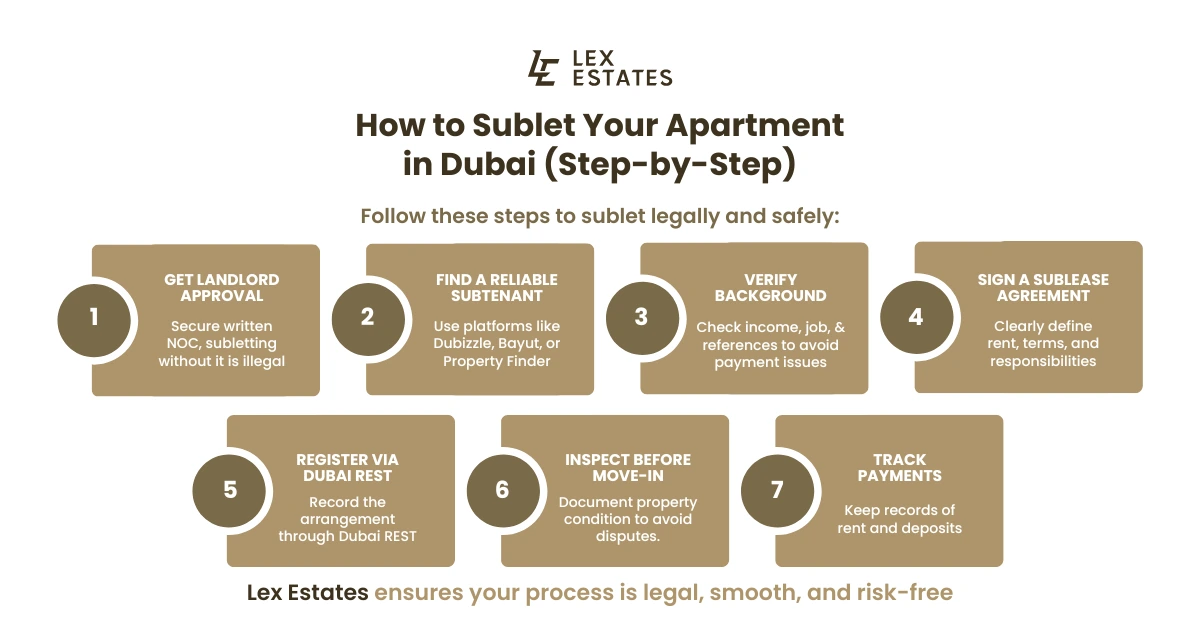
1. Get Written Landlord Approval First
Before taking any other steps, secure written approval from the landlord, ideally in the form of a no-objection certificate (NOC). This can be incorporated into the tenancy contract or provided as a separate signed letter. Without it, subletting is illegal under Law No. 26 of 2007.
2. Find a Suitable Subtenant
Advertise the property on reputable rental platforms like Dubizzle, Bayut or Property Finder. Be clear about the rent, duration, house rules, and available facilities. Taking care in finding a reliable subtenant protects you from disputes later.
3. Verify the Subtenant’s Background and Financial Capacity
Verify the subtenant’s employment status and financial capacity to meet rental payments. Request references or proof of income. This reduces the risk of payment defaults or disputes during the sublease period.
4. Prepare a Written Sublease Contract
Draft a sublease agreement that covers rent, deposit, duration, maintenance responsibilities, and exit procedures. Ensure it aligns with the terms of the main tenancy contract. A clear, written agreement protects both parties if a dispute arises.
5. Register the Arrangement Through Dubai REST
Register the subtenant through the Dubai REST app as recommended by the DLD. Consult your landlord or a licensed broker if you are unsure about whether additional registration steps apply to your specific property type.
6. Conduct a Pre-Move-In Property Inspection
Walk through the property with the subtenant before handover and document its condition in writing. A signed inspection report helps resolve any damage claims at the end of the sublease without dispute.
7. Arrange Rent Collection and Keep Records
Collect rent and the security deposit on the agreed schedule and keep complete records of all transactions. Keep the landlord informed if any payment issues arise.
How to End a Sublease in Dubai
To end a sublease arrangement, provide the subtenant with written notice at least 30 days in advance. Conduct a thorough property inspection and return the security deposit if there is no damage to the property.
Inform the landlord that the sublease has ended and update the arrangement through the Dubai REST app accordingly. If the sublease was conducted without proper legal documentation, ending it may require filing a case at the Rental Disputes Centre, which can be time-consuming and costly.
Subletting Duration in Dubai
Under Law No. 26 of 2007, the sublease period must not exceed the duration of the main tenancy contract and must remain active only while the main contract is valid. If the primary tenancy contract expires, the sublease arrangement cannot legally continue.
Rules For Sharing Accommodation in Dubai
The following occupancy and safety rules are set by Dubai Municipality and the DLD and apply to all shared residential arrangements:
- No more than four unrelated individuals may share a one-bedroom apartment. Families are not subject to this restriction.
- All occupied rooms must meet safety standards, including adequate ventilation and natural light.
- Kitchens and bathrooms may not be converted into living or sleeping spaces.
- The use of unsafe materials such as wood, cardboard, or gypsum board to create informal partitions is prohibited.
- Emergency exits and fire safety access routes must remain clear and unobstructed at all times, in accordance with Dubai Civil Defence guidelines.
Lex Estates: Your Gateway To Property Management in Dubai
The legal restrictions on subletting in Dubai are clear: you cannot sublet a property without the written consent of your landlord. Subletting without permission entitles the landlord to cancel your lease and file a case with the RDSC. It can also result in fines of up to AED 50,000 and additional penalties for overcrowding or unauthorised structural modifications.
To sublet legally, obtain formal written landlord approval, register the subtenant through the Dubai REST app, and prepare a separate sublease contract with clearly defined rent, terms, duration, and responsibilities.
Ready to make your Dubai property work harder for you? Talk to a Lex Estate specialist today.
Read out our Blog, Dubai Rental Laws Explained: Tenancy Rights, Eviction & Disputes.
Часто задаваемые вопросы
Is it illegal to sublet in Dubai?
Subletting is not illegal in Dubai, provided you have obtained prior written permission from your landlord. Subletting without written consent is a breach of the tenancy agreement under Law No. 26 of 2007 and can result in lease termination and fines of up to AED 50,000.
Can you sublet without the landlord’s permission?
No. Subletting without the landlord’s written consent is illegal under Dubai rental law. You may face lease cancellation, eviction of both the original tenant and the subtenant, and fines from the DLD or Dubai Municipality.
Is sharing an apartment illegal in Dubai?
Sharing an apartment is legal in Dubai, provided the landlord has given written consent and all occupancy rules are followed, including the limit of no more than four unrelated individuals in a one-bedroom unit. Sharing without consent or in breach of occupancy rules is illegal and subject to fines.