
Dubai’s real estate market operates under a clear statutory framework designed to protect investors while regulating ownership rights. Dubai property laws define who may own property, the form of ownership allowed, and the legal rights attached to each structure. This guide on types of property ownership and legal rights in Dubai is prepared by Lex Estates Property Advisors, offering free consultation on ownership structures, registration, and compliance before purchase or sale.
Forms of Ownership Rights in Dubai Properties
UAE recognizes several ownership and usage rights under Dubai real estate regulations. Each right carries different legal powers, limits, and registration rules. For a clearer comparison of ownership structures, see types of property ownership (Usufruct vs. Leasehold vs. Freehold) in detail.
Freehold (Absolute Ownership)
Freehold property in Dubai represents the strongest form of ownership available. Freehold owners may sell, lease, mortgage, gift, or pass the property to heirs. This right is governed by Dubai Law No. 7 of 2006 concerning Real Property Registration, read together with the UAE Civil Code. UAE and GCC nationals may own a freehold anywhere in Dubai. Foreign nationals may own freehold only in designated areas approved by the Ruler of Dubai. Freehold properties generally carry higher value due to permanence and full control.
Leasehold Ownership
Leasehold property in Dubai grants exclusive possession of a property for a fixed term, commonly between 30 and 99 years, without ownership of the land. Once the lease expires, rights revert to the freeholder unless renewed.
Leases under 10 years are governed by Dubai Law No. 26 of 2007 (Tenancy Law) and registered with RERA. Long-term leases between 10 and 99 years are treated as real property interests and must be registered with the DLD under Article 9 of Law No. 7 of 2006. Tenancy laws do not apply to long leases. Lease agreements often restrict structural changes; check out Legal Permissions for Renovation. Overall, these are best for lower entry costs without permanent ownership.
Usufruct Rights
Usufruct rights in Dubai allow a person to use and benefit from another person’s property while preserving its condition. These rights are recognized under the UAE Article 1333 of the UAE Civil Code and may last up to 99 years if agreed.
The usufructuary may live in the property or rent it out but cannot make major alterations. Usufruct agreements must be registered with the DLD to be enforceable. Termination may occur upon expiry, misuse, destruction of the property, or if the usufructuary later acquires full ownership (stated in Article 1344).
Musataha Rights
Musataha is a development-focused real property right defined under Article 1353 of the Civil Code. It allows the holder to build or plant on land owned by another party and to own the structures during the term.
The maximum term is 50 years. Under Articles 1355-1357, the musataha holder may finance, mortgage, assign, or transfer the right unless restricted by contract. Termination occurs upon expiry, default, court order, or if the holder acquires the land. Musataha rights must be registered with the DLD and are commonly used for long-term commercial projects.
Grant
Land granted by the Ruler of Dubai to UAE citizens. Conditions may restrict transfer, and the grant may be withdrawn.
Use and Residence Rights
Use and residence rights (under Article 1352 of the Civil Code) resemble long-term usage without ownership. While referenced in law, they are rarely registered independently and often operate like long leases. Changes in property use require approvals, for details, see Changing Property Usage (Residential → Commercial).
Ownership Structures: Who Can Buy?
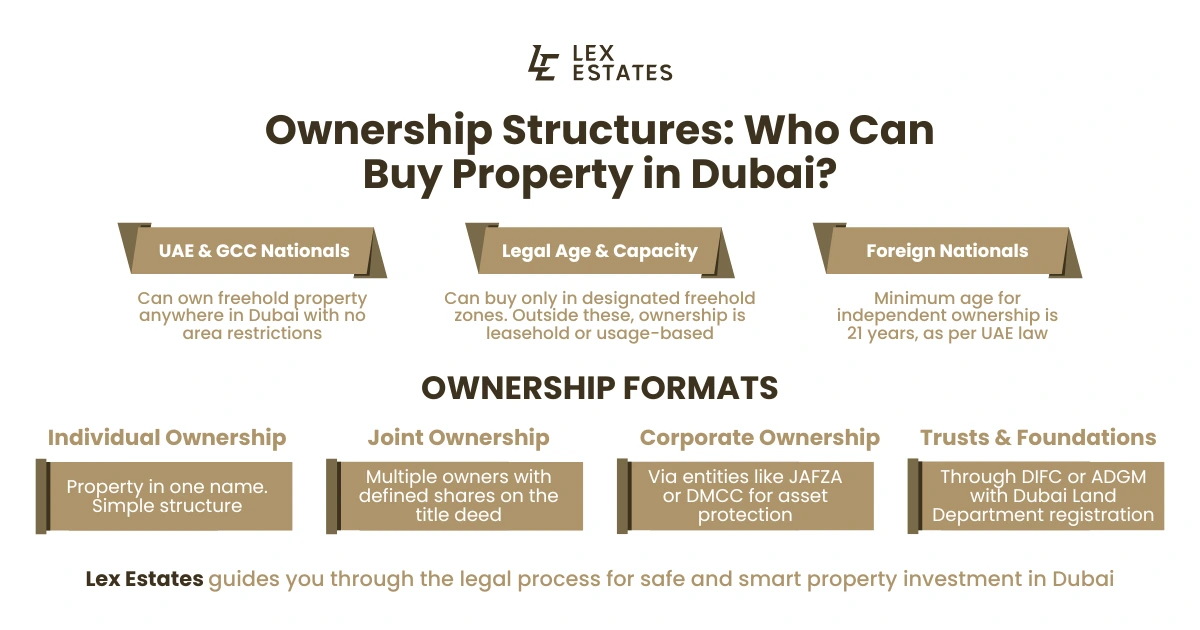
Dubai differentiates ownership rights based on nationality and legal capacity. Here’s who can buy and legal requirements for owning property in Dubai:
UAE and GCC Nationals
May own freehold property across Dubai without area restrictions. Companies fully owned by them may also hold property rights.
Foreign Nationals
Foreign buyers may own property only in designated freehold zones. Outside these areas, ownership is limited to leasehold or usage rights. More details are explained in Can Foreign Nationals Own Property in Dubai?.
Legal Age and Capacity
The legal age for independent property ownership is 21 years. This aligns with the UAE Civil Code and Personal Status Law. Ownership involving minors is explained in Can Minors Own Property in Dubai?
Ownership Formats
- Individual Ownership: Title deed issued in one name. Simple structure. Inheritance planning is recommended.
- Joint Ownership: Multiple owners share a property. Ownership percentages appear on the title deed. Law No. 6 of 2019 regulates jointly owned property. You can also combine two properties into one or get joint ownership with unequal shares.
- Corporate Ownership: Property may be held through JAFZA offshore entities or approved free zones like DMCC. This structure suits asset protection and share transfers.
- Trusts and Foundations: Property may be registered under trusts or foundations while remaining freehold, leasehold, or usufruct in nature. DIFC or ADGM structures are commonly used, with DLD registration required. This is detailed in Property under Trusts or Foundation.
Registration, Fees, and Mortgages
All legally recognized property rights in Dubai, including freehold, leasehold, usufruct, and musataha, must be registered with the Dubai Land Department (DLD) to be legally enforceable. Here’s an overview:
Dubai Land Department (DLD) Process
Registration requires submission of passports, sale contracts, and proof of payment. For off-plan properties, escrow accounts safeguard the buyer’s payments until project completion.
Fees and Taxes
Dubai does not charge capital gains tax or annual property tax. But here’s what it’ll cost to transfer property (as per Executive Council Resolution No. 30 of 2013):
- Freehold transfer: 4% of sale value
- Long-term leases: 4% of total rent value
- Usufruct: 2% of property value
- Musataha: 1% of contract value
Mortgages and Insurance
Mortgages are permitted under Dubai law for freehold and certain long-term rights. Mortgage registration costs 0.25% of the loan value. Banks may require residency, income proof, and credit history. Property insurance is sometimes required by lenders, so read if property insurance is mandatory.
Legal Rights and Obligations
Under Dubai property laws, owners receive defined protections and responsibilities:
| Category | Rights | Obligations |
| Ownership | Official proof of ownership | Pay transfer and registration fees |
| Income | Lease or earn rental income under Dubai Tenancy Law | Maintain accurate financial records for leased property |
| Transfer | Sell, gift, or transfer ownership freely (with compliance) | Ensure all transfers follow regulations |
| Use | Occupy property personally or commercially, per zoning laws | Follow building codes, zoning, and community regulations |
| Dispute Resolution | Access mediation, arbitration, or courts like RDSC | Cooperate with legal processes and dispute resolution |
Dispute Resolution: Dubai Property Management Authorities
Dubai authorities oversee all property transactions to maintain accurate records. RERA ensures compliance with tenancy and ownership laws, while the DLD confirms transfers and updates ownership details. For step-by-step guidance on keeping your property records current, see updating property details in DLD records.
Conclusion
Property ownership in Dubai offers multiple legal structures designed to suit residents and global investors. Freehold provides permanent control, while leasehold, usufruct, and musataha offer time-bound alternatives. Foreign buyers must confirm designated area eligibility and complete DLD registration. Special cases such as minors, joint ownership, and trusts require added legal steps. Reach out to Lex Estates for professional and legal help in Dubai’s property market.
Faqs
What is the buying process for property ownership in Dubai?
Buying involves due diligence, signing a sale agreement, and transferring ownership at DLD under regulated property laws.
What laws govern renting property in Dubai and tenant rights?
Dubai tenancy is regulated by Law No. 26 of 2007, protecting tenants from harassment, controlling rent increases, and requiring proper property maintenance.
Are there legal restrictions on foreign investors buying property in Dubai?
Foreign investors may own freehold or long-term usufruct rights in designated areas approved by Dubai authorities under established property ownership laws.