If you own property, hold a bank account, or run a business in the UAE, your answer to the “Is Sharia Law automatically applied in the UAE?” question determines what your family inherits when you die.
Sharia law does not automatically or equally apply to all UAE residents or property owners. For decades, Sharia inheritance law applied to everyone in the UAE by default, including non-Muslim expatriates. That changed in 2023. Federal Decree-Law No. (41) of 2022 on Civil Personal Status removed Sharia as the automatic default for non-Muslims who die without a will.
Let’s learn the application of laws after an owner dies in Dubai in detail.
Read our blog to Learn about What Happens If a Property Owner Dies in Dubai?
Learn about Joint Ownership & Death of an Owner in our recent blog.
Which Law Applies When A person dies in Dubai
Under the new law, a non-Muslim’s estate is distributed equally between genders, a direct departure from Sharia fixed shares. This was a landmark reform. But it is not a clean solution. It protects a specific group, under specific conditions, and still leaves significant legal gaps, particularly for property owners. Knowing where you fall is not optional. It is the difference between your assets going where you intended and going where the law decides.
For Muslims: Is Sharia Law Automatically Applied in the UAE?
If the deceased was Muslim, the Sharia law application is obvious, and Sharia law is directly applied for the distribution of the estate of the deceased.
According to Sharia law, sons receive double the share of daughters, and spouses receive fixed, limited portions. Distant relatives may be entitled to a share. A Muslim may draft a will, but it can only direct up to one-third of the estate freely; the remaining two-thirds follow Sharia fixed shares without exception. There is no legal mechanism of inheritance for a Muslim in the UAE to fully opt out, apart from creating legal structures such as foundations or trusts, where assets are owned by legal structures rather than the individual’s name. This applies to UAE nationals and Muslim expatriates equally. If you are Muslim and you co-own property in the UAE, your co-owner, regardless of their religion, needs to understand this reality before death forces the issue.
For Non-Muslims: The 2023 Reform Helps, But Doesn’t Eliminate Risk
The 2023 reform changed the default distribution for non-Muslims dying without a will. The new law provides that a non-Muslim’s estate will be distributed without gender distinction, fundamentally different from Sharia, where female beneficiaries receive smaller shares.
This is a meaningful improvement for intestate non-Muslim families. However, the reform does not resolve everything. For non-Muslims who own UAE real estate, the Civil Code introduces a conflict: where a will made by a non-Muslim involves real estate in the UAE, UAE law applies, creating a potential conflict between the two legal frameworks.
This means property ownership introduces complexity that movable assets, like bank accounts, do not carry. Relying on the 2023 reform without a registered will, especially when real estate is involved, still carries measurable legal risk.
When Sharia Still Applies to Non-Muslims
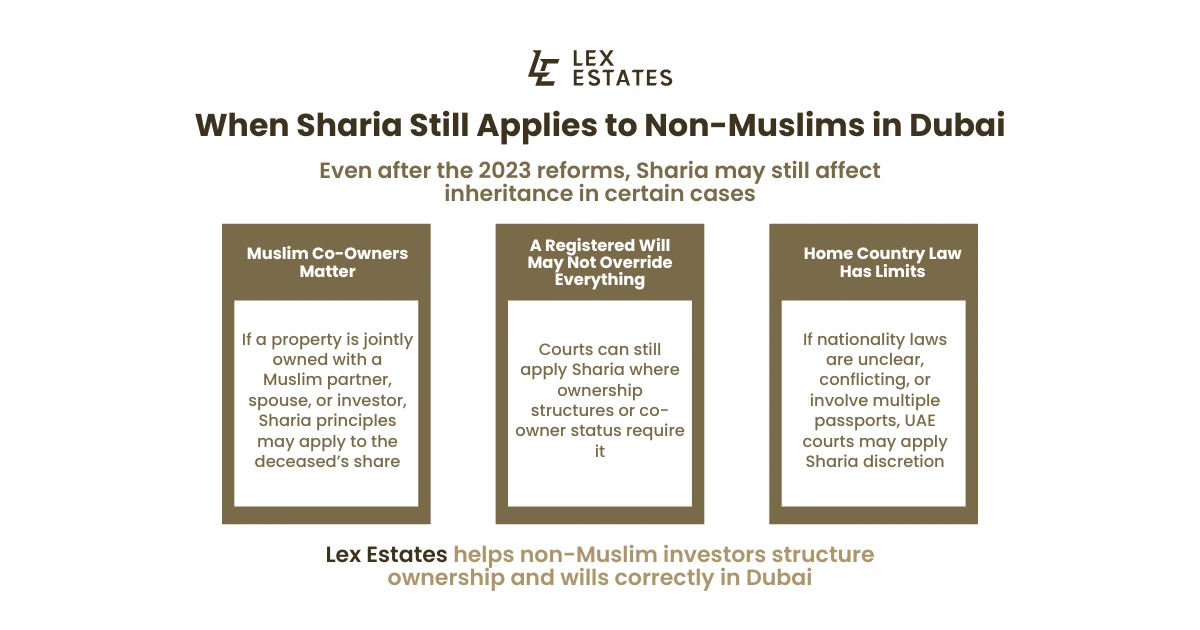
Even after the 2023 reform, Sharia can influence the inheritance for non-Muslims in specific situations, the most overlooked: the religion of your co-owner. Assets owned jointly with a Muslim individual will be subject to considerations under Sharia law, even if the non-Muslim co-owner has a registered will.
A non-Muslim expatriate co-owning a Dubai property with a Muslim partner, spouse, or business associate may find that Sharia applies to the deceased’s share upon death, regardless of their own religious status.
Additionally, the exception allowing non-Muslims to apply home country law does not apply where one party holds multiple passports, where the foreign law is ambiguous, or where that law directly conflicts with Sharia. In any of these cases, the UAE court retains full discretion to apply Sharia principles.
The Asset Freeze Applies to Everyone, Regardless of Religion
This is the consequence that no reform has touched. All personal assets of the deceased, including bank accounts, will be frozen until liabilities are discharged, and shared assets will remain frozen until inheritance is determined by the local courts.
Whether Sharia applies or not, the surviving co-owner cannot sell, mortgage, or access the deceased’s share until the court resolves the matter. This freeze can last months, sometimes over a year. The 2023 reform changes how assets are distributed once the freeze lifts.
It does not prevent the freeze from happening in the first place. Every joint property owner in the UAE, regardless of religion or nationality, is exposed to this risk the moment a co-owner dies without proper legal planning in place.
A Foreign Will Does Not Protect Your UAE Assets
Many expatriates assume a will registered in their home country covers their UAE property. It does not. Only a valid UAE will hold up legally in the UAE. Foreign wills, verbal wishes, and informal agreements mean nothing without formal recognition.
A foreign will can be submitted to UAE courts, but it must be translated into Arabic, attested in the country of origin, and further attested by the UAE Ministry of Foreign Affairs, a process that is costly, slow, and uncertain. For expats in the UAE, the two primary will registration options are the DIFC Wills Service Centre, a civil system tailored for Dubai, and the Abu Dhabi Judicial Department, which allows bilingual wills covering all Emirates.
For Dubai property owners specifically, a DIFC-registered will is the fastest and most legally certain route available.
The Bottom Line
The answer to “Is Sharia law automatically applied in the UAE?” differs according to the religion of the deceased. Sharia is automatically applied to all Muslims in the UAE, no exceptions. For non-Muslims, the 2023 reform removed the intestate default, but it does not eliminate risk for property owners, those with Muslim co-owners, or those whose assets cross legal jurisdictions. The reform changed the default. It did not remove the need to plan. A UAE-registered will, a co-ownership agreement that addresses death, and specialist legal advice remain the only reliable protection for any co-owner, any religion, any nationality.
If you co-own property in the UAE and haven’t reviewed your legal position, now is the time.
Связаться Lex Estates for buying or selling a property in Dubai; our experts are always right at your service. Call us today.
Часто задаваемые вопросы:
Does the 2023 UAE inheritance reform mean non-Muslims no longer need a will?
No. The reform removed Sharia as the automatic default for non-Muslims dying intestate, but it does not resolve inheritance for UAE real estate, joint assets held with a Muslim co-owner, or complex cross-border estates. A registered will, either through the DIFC Wills Service Centre or the Abu Dhabi Judicial Department, remains the only way to guarantee your assets are distributed exactly as you intend.
Can a non-Muslim choose which country’s law applies to their UAE estate?
Yes, but only with the right documentation in place during their lifetime. Non-Muslims can elect to have their home country’s inheritance law applied to their UAE estate, but this election must be formally recorded in a recognized Will in the UAE. Without it, UAE law applies by default. Where real estate is involved, UAE courts may still override a foreign law election if it conflicts with local legislation or public policy.
What happens to a jointly owned UAE property if one owner is Muslim and the other is not?
If a co-owner dies and if he/she was a Muslim, then the owner’s share will be distributed according to Sharia fixed shares upon their death, regardless of the co-owner’s religion or any agreement between the parties. If the deceased owner was not a Muslim, and there is no Will, then the UAE Law on Civil Personal Status applies. The surviving co-owner retains their own registered share but has no automatic right to the deceased’s portion, which has to be distributed through the court process.