
Protecting property with a registered will is one of the most important legal steps for property owners, investors, and expatriates in Dubai and across the UAE. Without a registered will, when a property owner dies, your assets may be frozen, delayed, or distributed according to default inheritance laws instead of your personal wishes.
A registered Will confirms your real estate, bank accounts, business assets, and investments are transferred smoothly to your chosen beneficiaries while avoiding legal complications and family disputes.
Why Protecting Property with a Registered Will is Essential
Many residents assume their assets will automatically transfer to family members. However, in the UAE, this is not always the case.
If someone passes away without a registered will:
- Bank accounts may be frozen
- Property transfers may be delayed
- Legal disputes may arise
- Guardianship issues may occur
- Default inheritance laws may apply
Registering a will ensures your property is distributed exactly as you intend, providing security for your family and peace of mind.
Benefits of Protecting Property with a Registered Will
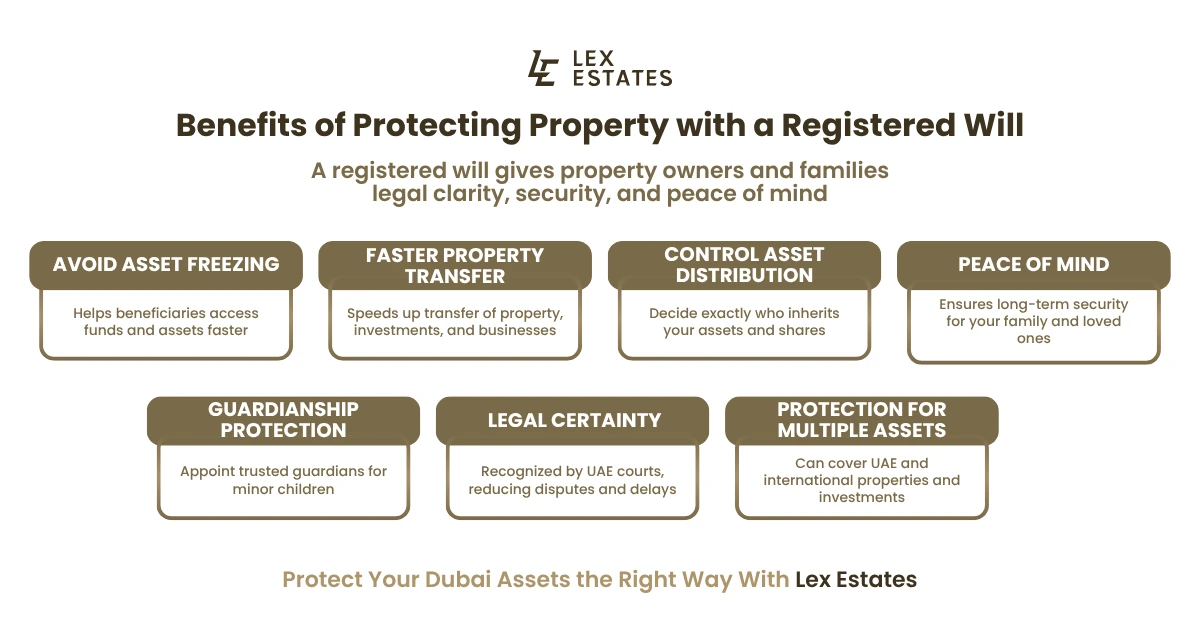
Registering a will offers legal clarity, financial security, and peace of mind for property owners and their families. It ensures your assets are distributed according to your wishes while minimizing delays and complications.
Avoid Asset Freezing
A will helps prevent bank accounts and assets from being frozen after death. This allows your beneficiaries to access funds and manage expenses without unnecessary delays.
Faster Property Transfer
With a registered will, real estate, investments, and business assets can be transferred directly to your chosen beneficiaries. This reduces lengthy legal procedures and speeds up the probate process.
Full Control Over Asset Distribution
A will allows you to decide exactly who inherits your property and in what proportions. This ensures your assets are distributed according to your personal wishes.
Appointment of Guardians for Children
Parents can appoint legal guardians for minor children in a registered will. This helps avoid uncertainty and ensures your children are cared for by trusted individuals.
Legal Certainty and Enforceability
Registered wills are legally recognized by UAE authorities and courts. This provides clarity, reduces disputes, and ensures smooth execution of your estate.
Protection for Multiple and International Assets
A registered will can cover property across different Emirates and even international assets. This ensures complete protection of your estate regardless of location.
Peace of Mind for You and Your Family
Knowing your property and assets are legally protected provides long-term security. It also reduces stress and uncertainty for your loved ones during difficult times.
Understand Which Law Currently Applies to Your Estate
Before registering a will, every expatriate needs to know where they stand legally, because the answer differs based on religion, nationality, and asset type.
For Muslim:
Sharia law applies to your entire estate in the UAE. You can direct up to one-third of your assets freely in your Will. The remaining two-thirds are distributed per Sharia fixed shares, regardless of what any document states. The ADJD now allows non-Emirati Muslim expatriates to register civil wills, but within these boundaries.
For Non-Muslims:
Federal Decree-Law No. 41 of 2022, effective February 2023, removed Sharia as the automatic default for non-Muslims dying without a will. The new statutory default distributes 50% to the surviving spouse and 50% equally among children, regardless of gender. This is more equitable than Sharia, but it is still a formula, not your instructions.
Jointly Owned Property With A Muslim:
Sharia applies to your co-owner’s share regardless of your own religion or will status. This is one of the most overlooked legal risks in UAE joint property ownership.
The Right Will Registration Route
Expatriates in the UAE have three main options for registering a will. The best choice depends on your assets, budget, and preferred legal process.
DIFC Wills Service Centre
This is the best option for non-Muslim expatriates with significant Dubai assets, operating in English under a common-law framework with direct enforcement.
Cost: From AED 10,000 (including legal drafting).
Abu Dhabi Judicial Department (ADJD)
It is the most affordable and flexible option, valid across all seven Emirates, and can be completed online. Both Muslim and non-Muslim expatriates can benefit from this type of will registration.
Cost: From AED 950.
Dubai Courts
Registering your will with Dubai courts is an onshore option requiring Arabic or bilingual documents and is less common for expatriates, but still legally valid.
Cost: Around AED 2,167.
Quick Tip:
- Choose DIFC for premium protection
- Choose ADJD for affordability and UAE-wide coverage
- Choose Dubai Courts for local onshore registration
Step-by-Step Guide to Protect Property with a Registered Will
Creating a registered will is a simple process when you follow the right steps. Follow this step-by-step process for a smooth and easy registration route.
Step 1: List Your Assets
Start by creating a complete inventory of your assets in the UAE and abroad. This includes real estate, bank accounts, investments, business shares, vehicles, and valuable personal belongings. A detailed asset list helps avoid omissions and ensures a smooth transfer to beneficiaries.
Step 2: Choose Beneficiaries
Decide who will inherit your assets and clearly specify how they should be distributed. You may assign specific assets to individuals or divide your estate using percentages. Being clear reduces confusion and helps prevent family disputes.
Step 3: Appoint Executors
Executors are responsible for managing your estate and carrying out your wishes after your passing. Choose trustworthy individuals who can handle legal, financial, and administrative responsibilities. It is also advisable to appoint a backup executor if your primary choice is unavailable.
Step 4: Draft Your Will
Work with legal professionals to draft a will that complies with UAE laws and reflects your intentions. A professionally drafted will reduces legal risks, avoids ambiguity, and ensures enforceability. This step may also include appointing guardians for minor children if applicable.
Step 5: Register Your Will
Register your will with an authorized authority such as DIFC Wills, Abu Dhabi Judicial Department (ADJD), or Dubai Courts. Registration ensures your will is legally recognized and can be enforced without delays. This step is essential for protecting your property and beneficiaries.
Step 6: Review Regularly
Review your will regularly and update it after major life events. This includes marriage, divorce, purchasing property, or changes in family circumstances. Keeping your will updated ensures your wishes remain accurate and legally valid.
When to Register and When to Update Your Will
You should register your UAE will as soon as you purchase property, not later. Your legal risk begins the moment your name appears on the title deed, making early registration essential for protecting your assets.
After registering your will, it should be reviewed and updated when major life or financial changes occur, such as:
- Marriage or divorce
- Birth of a child
- Purchasing a new property in the UAE
- Death of an executor, beneficiary, or guardian
- Significant changes in asset value or ownership
It’s also important to note that a DIFC Full Will automatically covers assets acquired after registration, while a Property Will only covers assets specifically listed in the document.
Learn about DIFC Wills Service Centre (formerly DIFC Wills & Probate Registry) Explained For Investors
Also Learn more about Inheritance & Wills in Dubai Real Estate: Protecting Your Assets
Protect Your Property with Lex Estates
Protecting property with a registered will is the only way to transfer your estate to your family after your death. Whether you’re looking to buy or sell property in Dubai or anywhere across the UAE, Lex Estates is here to guide you at every step. Beyond helping you find the right investment, we ensure to support you with the right guidance for important matters like property protection, ownership planning, and registered wills.
Связаться Lex Estates today to discuss your property needs, and we’ll connect you with the right professionals to ensure your investment is protected and your decisions are made with confidence.
FAQS
What is a registered Will in Dubai?
A registered Will in Dubai is a legal document that ensures your property and assets are distributed according to your wishes after your death.
Why is a registered Will important in Dubai?
A registered Will prevents asset freezing, reduces legal delays, and ensures your property transfers smoothly to your beneficiaries.
Can expatriates register a Will in Dubai?
Yes, expatriates can register Wills through DIFC Courts, Dubai Courts, or Abu Dhabi Judicial Department.
What assets can be included in a registered Will?
You can include property, bank accounts, business shares, investments, and personal belongings.
Can a registered Will cover international assets?
Yes, some Wills, like DIFC Wills, can cover assets both in the UAE and internationally.
How much does Will registration cost in Dubai?
Costs vary depending on jurisdiction, but Dubai Courts Wills are generally more affordable than DIFC Wills.